Sunday, August 31, 2025

SEPTEMBER 1, 1978 - JOURNAL ENTRY - EAST VILLAGE

Flowers are exploding all across the East Village community gardens. The temperature is in the 90s. The air in our apartment has no oxygen. The streets only have a little more. Alice and I have lived together for the last month. I haven't worked a day. Alice is heading home to West Virginia for Labor Day, the traditional end of America's summer, although astrologically the equinox is three weeks away.

I wander downtown. The Jones Diner is packed with blue-collar workers. The staff is third world. Two secretaries shriek in New york accents. Their boyfriends remain silent and eat their lunch. I order a bagel and coffee. At 1 the diner clears out. Everyone has gone back to work. Two Greek children draw in books at a corner table. Strangely they speak Spanish together.

Has anyone ever changed their sex to become a hermaphrodite?

A BEACH DREAM
I was at a seaside resort with Alice
Our cottage was a wreck.
My Uncle Jack visits with kids, all of them six years-old
He complains, "This place is a mess."

I recall his first beach house on the Cape
It was so big
Sand was deep on the wood floors
My Aunt never cleaned anyplace
later we are at the beach
I rescue a child from drowning
I drag him onto the pier
I lose my balance and fall into the water Ropes entangle my limbs

I wake up before dying.

<

September 1, 2021 - Brooklyn

A hard rain all day. I haven't left 387. I wrote from the 1979 journal, napped, and ate several small meals. I only spoke with Jake and Brigette and then only briefly. I have really talked with anyone on the phone or texted someone about nothing.

Brigette painted me as a hermaphrodite. They had heard my tale of the Hermaphrodite statue at the Louvre. Their friend Soap had a tattoo of l'Heramphrodite on her arm. I would love to see it one more time, except it's raining buckets in Brooklyn and I'm not going anywhere, until after my procedure at NYU. Trapped like a laboratory rat seeking reincarnation as a marble statue.

Labor Day 2023

It's Labor Day Weekend.

Labor Day is not Workers Day.

That Holiday is May 1st.

Workers of the World unite.

No such slogan exists for Labor Day. That holiday was promoted by the Central Labor Union and the Knights of Labor, to oppose May Day, which commemorated the 1885 convention of the American Federation of Labor, which passed a resolution calling for adoption of the eight-hour day effective May 1, 1886. Four days later the Chicago Police and Pinkerton agents attempted to clear a workers' protest from Haymarket Square. Someone threw a bomb, killing a policeman. Eight others died. No one claimed responsibility. The blame fell on anarchists. Four anarchists were executed by hanging. one died of suicide by a smuggled blasting cap. They have been hailed as martyrs every May Day since.

Conservative Democratic President Grover Cleveland had seen May 1 might strengthen socialist and anarchist movements that backed the May 1 commemoration around the globe. According to Wikipedia in 1887 he publicly supported the September Labor Day holiday as a less inflammatory alternative, formally adopting the date as a United States federal holiday through a law that he signed in 1894.

Falling on the first Monday of September the three-day weekend became a popular end of summer holiday. Scholl began tgat next week and even at the age of 71 My body and soul instinctively feels the urge to attend the next grade. BBQs, beaches, drinking beer before the summer is over, but in the heated seasons of the mass species extinction summer might never end. at least that is what it feels like in Brooklyn with a breeze blowing through Metro Tech Plaza.

Tomorrow Hotdogs and the Rockaways.

Riis Park and naked.

ps Only the USA, Canada, and Australia do not celebrate May 1 as well as the Vatican, because May 1 is also a pagan holiday.

Koh Samui 1990

I first arrived in Thailand 35 years ago After traveling on a westward bound round-the-wotld ticket from John at PanExpress, New York - Biak - Bali - Java - Sumatra - Singapore. April. I rode the train north up the Ka Peninsula to Surat Thani. I got off the train at night. A midnight ferry took me to the island. I got a bungalow on the a coal beach. It was quiet and beautiful. I woke up in the morning to have breakfast and exited into the bright sunlight. Then two housekeepers splashed water on me. I laughed. I was so angry until they said it was Songkran. Water Festival. Fun, fun, fun. I miss my family. I miss Thailand.

Saturday, August 30, 2025

NAPS OF THAILAND by Peter Nolan Smith

When a Chinese general was asked about how the People's Army were defeated by the Vietnamese in 1979, he replied, "We get up at 5am and they get up at 4."

The draconian work ethic of NVA seemed to have been sapped by the torrid climes closer to the equator, because Thais and Laotians are epic sleepers with an uncanny ability to find comfort in conditions better suited to a CIA rendition camp.

Some farangs attributed this hyper-sleeping habit to oriental lassitude, however their Eurocentric observations are way off mark.

Most Thais wake before dawn to work in the rice fields until the heat hits treacherous body-sapping temperatures and then 'Khon tam khao' retreat from the sun for a good meal followed by a better nap or nge'ep before returning to the fields for the long afternoon.

This rice farming tradition has been transported to the cities where workers labor from dawn to dusk six days a week.

Having lived in the South of France, where siestas are a valued cultural treasure, I often defended the Thais and other Asians' sleeping habits.

"Naps are good for you," I once said at the Buffalo Bar.

"So explain to me why bar girls sleep twenty hours at a clip," an English bar-goers asked in Pattaya. Jim had been here for years. His vocabulary in Thai was limited to orders for more beer and sexual propositions.

"Only can be several reasons." I'd been in the Orient since 1990.

I didn't have all the answers.

Just some of the right ones.

"Like what?" Jim was eying his date. The plump bargirl seemed alert for the moment. The fifty year-old mustn't have paid her yet.

"First is that she's exhausted from having sex with you." Many farangs in Thailand exist on a diet of Viagra and alcohol.

"Could be." The bar-goer smiled with pride.

"Second, she could be on ja-bah and crashes after sex." His girl's fatness excluded her huffing meth. She was a healthy eater.

"No way. The cops piss-tested her at Marine Disco the other night. She came up clean."

"Well, that leaves only one other explanation and this comes from a very knowledgeable Mama-san of a go-go bar. She said the reason most of these girls sleep so much is that they're trying to escape the reality of having to have sex with a fat farang and would rather live inside a sleep world until they have enough money to rejoin other Thai people. Of course this couldn't pertain to you since you're such a sex hero."

Jim tipped the scales over 280 and his age was a 20th of Methuselah. No one had called him 'sexy' since he was in his teens and that person had probably been the parish priest. For an Englishman Jim had good smile considering he had half his front teeth.

"I'm not so sure about that." Even Jim recognized that he was no Apollo.

Me neither, but I like hearing girls tell me I'm the best I ever had.

It's a lie which improved with age and I sleep in peace content to accept a well-intentioned lie.

Sleeping well is a talent an old man admires with age.

Those damn Thais.

There is nothing like a good nap and as Carrie Snow once said, “No day is so bad it can't be fixed with a nap.”

Ching ching.

Labor Day Weekend 2021

Written Sep 3, 2021

Labor Day Weekend traditionally marks the end of summer in the USA. Millions of Americans flocked to the shore, lakes, mountains, parks, and backyards for a last gasp of enjoyment before going back to work. Few realize that the holiday was established by President Grover Cleveland as a peace offering after his ordering in troops and federal marshals to break up the 1894 Pullman Strike outside Chicago.

The American Railway Union had struck and boycotted the Pullman Coach Company throughout the summer. Executives had cut workers' wages, but refused to lower prices at the company stores or rents in their company towns. Nearly 200,000 railroad workers walked out across the country effectively shutting down transportation from coast to coast.

President Cleveland called in 12,000 federal troops to protect corporate property and escort scabs or strike-breakers across the picket lines. In the ensuing violence thirty strikers were killed and many others wounded. Public opinion favored the action and ARU leader Eugene Debs was imprisoned for six months. Further investigation faulted George Pullman with inciting the unrest.

Immediately after the end of the strike Cleveland designated first weekend in September as Labor Day rather than International Workers Day in May due to its association communists, anarchists, and socialists.

Today I asked twenty people in Fort Greene, "Why do we have Labor Day?"

Most said to celebrate the end of summer, a few replied that they didn't know, and two answered to honor the working man without any mention of the struggle to win an 8-hour day, a minimum wage, health care, social security, and many other commonly accepted entitlements for the working classes.

The Republicans, the Proud Boys, the anti-vaxxers and Bible Tumpers are too ignorant to know exactly the benefits, which were won by those strikers and the GOP has refused to enact any legislation to overhaul the national infrastructure, preferring for the country to crumple into dust rather than hired hundreds of thousands of Americans for good-paying jobs.

An annual expenditure $100 billion will transform America into a nation of workers.

Do not give them up without a fight.

The police are workers working for the bosses.

They are not our friends when in uniform, except when they remember that they are union members too.

Workers of the world unite.

AUGUST 30, 1978 - JOURNAL ENTRY

Summer will be over soon, the equinox is only three weeks away. winds from the North signal the impending change in seasons. the rustle of leave underfoot foretell the approach of autumn. Last night a cold gust caught me unaware. Winter, the coldest season of all hates to be forgotten.

A delicate butterfly bobbles against the August sky. Its shoulder-high flight dodges cars and trucks on 1st Avenue I pray out a warning to the danger The butterfly soars above the traffic. Preserving its beauty And the hope for mine.

I want to write a short story combining my trips to Evans Notch, the Moose Bar and Grill, and Peter Gorr's spooky mountain retreat. Lately I have been inspired by reading HP Lovecraft and sense the mysteries of the Other Side.

Our Boy Scout troop camped atop Evans Mountain next to the ruins of a stagecoach inn, a two-story wreck with a gaol in the damp basement. That evening the troop leader told a campfire tale of three Dartmouth students vanishing the night before the Thanksgiving of 1943. We went to sleep scared to the marrow.

As a teenager I checked the records from the surrounding towns without finding any information affirming the incident that although the East Village isn't very conducive to traveling through dimensions other than with LSD.

Last night Alice was hurt by my staying out all night. Her decision to sleep alone drives me out of the apartment, despite loving me and wanting to share all her pleasures and woes. Once I woke, she said she had risen at dawn and watched me sleep for several more hours.

"Your chest rose and fell so gently, but your sleep seemed like too much a waste of the day."

Monday, August 25, 2025

JFK on the March to Washington

Written August 13, 2013

Two years ago the BBC News reported that JFK had attempted to block the 1963 March on Washington for fear of violence and painted a picture of a president apathetic to the plight of blacks in America, however the article ignored to mention the Justice Department descending on Birmingham after the police chief had sicced dogs on peaceful Civil Rights demonstrators and had focused on Martin Luther King's Statement that 'the events of the early summer had transformed the struggle for black equality from what he called a "Negro protest" into a "Negro revolution". America, he feared, had reached "explosion point".

For the most part the violence was one-sided with white supremacists bombing churches and firing at SNCC volunteers, however the specter of a slave uprising scared whites and JFK was concerned about losing the South to the GOP on the issue of equal rights.

Upon hearing on the March on Washington JFK called out the National Guard and the FBI spied on march organizers and radicals opposed to non-violence.

Snipers were placed along the parade route.

But on August 28 there was no violence.

JFK listened to King's I HAVE A DREAM SPEECH.

"He's good - he's damned good”

I thought the same thing in Boston.

I hoped for a better day.

And so did JFK.

After the speech the black leaders came to the White House.

It was hard to stop being a white man and see all men as men, but this country was founded on the tenet that all men are created equal.

JFK understood that and his brother even more.

We are all family.

March On DC Plus 60

Written 8/26/2013

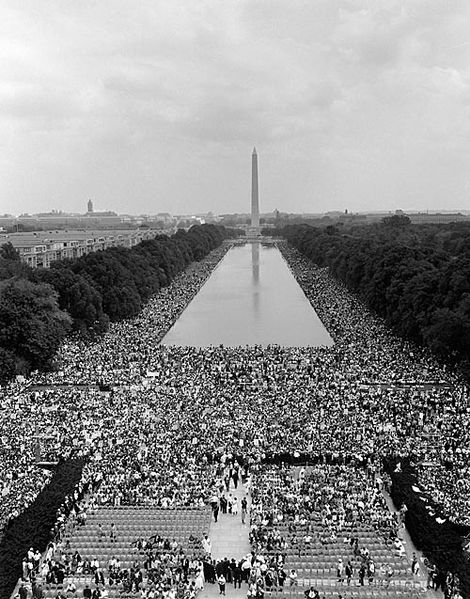
August 28, 1963 hundreds of thousands of Americans assembled in Washington DC to march for Jobs and Freedom. They gathering had a good number of whites, but the marchers were predominantly black and very brave considering how the police treated any congregation of coloreds with violence.

The DC police had mobilized the entire force and its chief had called in the National Guard to maintain order and had gone so far as to forbid liquor sales in the capitol.

The sound system at the Lincoln Memorial had been vandalized and organizers had demanded Attorney General Robert F Kennedy for a replacement.

The US Army made the necessary connections and the next day the area around the Reflecting Pool was occupied by the largest gathering of African-Americans ever held in the USA. The mainstream media expected mayhem. None expected peace from blacks. They were wrong.

A moment of silence was observed for the passing of W. E. B. DuBois and according to Wikipedia Roy Wilkins told the crowd, "Regardless of the fact that in his later years Dr. Du Bois chose another path, it is incontrovertible that at the dawn of the twentieth century his was the voice that was calling you to gather here today in this cause."

Speakers from the SNCC, CORE, and SCLC extolled immediate action against racism.

With good reason.

Martin Luther King Jr.'s took to the podium.

I was twelve years old and watched his speech on a Zenith TV.

I knew no black people.

I lived in a suburb south of Boston.

His words struck my soul.

The preacher had a dream and I have shared that dream throughout my life.

One day we will enter the Promised Land.

To hear his words please go to the following URL http://www.youtube.com/watch?v=smEqnnklfYs

The Weirs Of Wychmere

Weir fishing has existed since time immemorial.

In 1913 subway excavators in Boston discovered ancient wooden fishing weirs dating back 3500 years, although recent research suggests that the Back Bay site had existed almost 9,000 years ago and supported 30-50 families.

The melting glaciers on the Laurentian Granite Shield changed the influx of tides and the native people adapted their methods to suit the new climate.

On summer vacations to Cape Cod my brother and I sailed out to the abandoned Harwich weirs. The wooden stumps were connected by rickety walkways and covered with tattered shrouds of netting strewn with fish skeletons.

The gulls loved the weirs.

They scared my older brother.

Me too.

Recently I thought about them asked my cousins and family, if they remembered the weirs.

They all said no.

But once the weir fishermen provided hook fishermen with bait from the sea off Wychmere Harbor.

In days long gone.

Life was different.

Better?

Maybe.

Dolls Lookalike

Post David Johansen' death this summer my friend Dakota send an email was sifting through photos of Johansen and thought, he looks like Peter. Not surprised I’m not the only person who has made the comparison. 

Enjoy those beaches and little sights in life. Often while withdrawing, one of the worst moments was seeing a beautiful sight and being unable to fully appreciate it because of the condition I was in. Makes you understand why Buzz Aldrin became a total drunk after returning from Space.

I replied

I was once at Max's 1978 and the lanky singer from the Student Teachers approached our table and said, "We're covering Personality Crisis in our set." 

"Thanks. Key of G please."

A strange look. Then I realized he thought I was David Johanson.

The lead singer of the New York Dolls and I shared the same hair and big head and a savage face. Later in that decade in London at night on the King's Road someone asked, "Are you Gary Numan?"

My blonde girlfriend thereafter called me 'suedehead', since the pop star had a smooth coif. Lisa and I lasted to the end of 1979. I've never seen her after running into her in Paris at Albert de Paname's Nouvelle Eve in Pigalle. 1985.

The world will exist with or without us. I've had a good life. On the beach at Ditch Plains. Mist covering a gray sea. A light easterly wind . A waist high swell. A score of seal skinned surfers on the break. On the beach tourists. Talking. I wander down the beach. Not to silence, but the sound of the waves.

I plan on living forever for ever how long that is. At least longer than David Johansen. I doubt anyone ever accuse him of looking like me.

Never A Tilt

Pinball machines were viewed by the righteous, as if the souls of young people were threatened by helping a steel ball defy gravity, then again the Church had sentenced the humanist Galilleo to a long house arrest for his assailing the Vatican's belief that Earth was the center of the universe. or that's how I remember his sin. The Dark Ages were Dark, because the Vatican destroyed all sources of knowledge beyond the New and Old Testaments, except those out of their reach in the Moorish kingdoms, India, China, and the empires of the New World.

My family lived in a pink split-level ranchhouse built on an old army base in the BlueHills south of Boston. My mother insisted that we attend St. Mary's of the Foothills. The Sisters of St. Joseph were a teaching order. Their students learn that the Earth was round, Latin, Geography, Math and lessons of Catholcism from the Baltimore Catechism. Thankfully as an atheist in the early 1960s I had freed myself from their ignorance of the One and True Faith. I shared my devotion with no one and wandered the Blue Hills, played sports in our backyard and in 1964 after school walked to Mattapan Square across the Neponset. Pizza 25 cents and the Ashmont trolley was free connecting with the T to downtown Boston.

During my childhood my Irish nana had taken my older brother and me on trips to Washington Street. A prayer and confession at The Shrine of St. Anthony. A hot dog on a grilled bun at WT Grant's followed by a movie at the Orpheum. Always during the day, although myeyes were drawn to bright lights of the amusement centers. Pinball, skeet, and teenagers in leather. Nana loved Robert Mitchum as a bootlegger in THUNDER ROAD. She had brewed beer in the basement of her three-decker in Jamaica Plains, but her grip tightened passing those dens of inequity. They were off-limits for good boys, but not for long.

At the age of twelve I rode the Ashmont trolley first to Mattapan Square and then the T to Washington Street, heading straight to the amusement center with my pocket filled with quarters from my newspaper route. No one challenged my entry. Men and boys of all ages stood before a wide array of pinball machines. I watched to learn the game. Shooting the ball, flippers, bumping thr machine. The defiance of gravity. I like the name of Bally's ACES HIGH. I barely broke a thousand my first game, but my skill improved that day and every year until I moved to New York in 1976.

In Times Square I was one of the best. I spent hours at the amusement of Broadway. At night I hung out at bars. Always getting top score. After leaving Park Slope I ended up at CBGBs. The punk bar on the Bowery had rock, pinball, and loose women. The Ramones, rock musicians, and Hells Angels dominated the two machines. I was better than them, having honed my skills in Times Square, but respected tgat this was their turf, but as the nights in CBGBs got late, the pinball machines were q

Damn Les Habitants -1971

Written 2011

My introduction to French was via the heavy accent of Pepé Le Pew. The cartoon skunk appeared on TV every Saturday morning in Maine during the 1950s. Pepe never got the girl. Skunks smelled bad and supposedly the French also never bathed with soap. France was across the Atlantic Ocean, but another France was much closer to my home across the harbor from Portland.

Quebec.

The largest minority in Maine was the French Canadians. They worked in the mills and logging camps. A radio station from Montreal played songs for these workers and their families. I listened to them on a ROCKET RADIO, Miniman Model MG-302.

Somehow attaching its alligator clips to the metal frame of my bed powered the crystal. I listened to the French music. None of the words had any sense, but several evenings a week in the winter a hoarse voiced announced the hockey games from ‘le Forum’.

The Canucks in Maine supported the Canadians or ‘les Habitants’. The team dominated hockey in the NHL, winning six of the decades’ Stanley Cups. My father came from an old New England family. We rooted for the Boston Bruins. They always lost to the Habs just like Pepe le Pew never got the girl.

My father moved our family from Maine to the South Shore of Boston in 1960. My ROCKET RADIO was upgraded to a Japanese transistor and I caught the Montreal station when the atmosphere was clear of static. The music was changing from smooth to pop. A young singer was very popular with teens.

Francoise Hardy was the ‘Yeh-Yeh Girl’.

I bought 45s in Mattapan Square. The nuns at Our Lady of the Foothills taught us French. I understood the lyrics and plotted to meet her one day.

Pop lost favor for rock.

I loved the Sultans' garage rock version of LE POUPEE QUI FAIT NON.

But some things never changed.

The Bruins continued to lose to the Canadians with regularity and the Montreal team captured four Stanley Cups in a row, until the Bruins’ Bobby Orr scored a Cup winning goal in 1970. The victory was against an expansion team, the St. Louis Blues, but this was their first Cup since 1940.

They had been lucky to avoid the Canadians during the playoffs.

They never lost to the Bruins.

April 1971 the Bruins were favored to beat the Canadians in the semi-finals. The goalie Gerry Cheever allowed one goal in the first meeting. It was Easter Week and my three friends and I were driving down to Fort Lauderdale for Spring Break.

We had rented an apartment across from the Elbow Room, famed from the 60s movie WHERE THE BOYS ARE.

Below Washington we entered the Deep South. We were longhairs and rednecks hated hippies almost as much as we hated the Canadians.

Our only stops were for gas and food.

Throughout Georgia we listened to WBZ's broadcast of the second game between the Habs and Bs. The Boston-based radio station had a strong 50,000 watt signal. The Bruins went up 5-2 at the end of the 2nd period. The signal died at the Florida border.

In my mind the Bruins were returning to the Stanley Cup. We stopped for complimentary OJ at the state hospitality stop and drove the rest of the night to reach our destination at dawn.

I had never been to Florida before and I marveled at the palm trees, the Gulf Stream, and co-eds in bikinis.

Our apartment had a view of it all. I went down to the store for beer and picked up the local newspaper, opening the sports section. I blinked several times in disbelief before the printed tragedy hit me with full force.

The Habs had come back from the abyss and scored 5 goals in the 3rd period.

The series was tied at 1-1.

The Bruins pushed the Canadians to the limit and lose game 7.

That misfortune was repeated often over the next four decades, but two nights ago with history on the line the Bruins played the Habs in another game seven. I was watching from Mullanes across the street from Frank's Lounge, which does not do hockey.

The teams were tied into OT.

I was ready for the loss, but the Bruins of 2011 were not those of 2010 or 1971. We won the game and I toasted my team with another beer. I was the only Bruins fan in the bar. It felt good and I lifted my glass one more time. “To Pepe Le Pew.”

I hope that somewhere he got the girl in the end.

Friday, August 22, 2025

Sleeping In A Tent

I sleep in a tent
Alone
On a beach
The rain
Sounds different on canvas
Less muted than on a roof
Comforting
That I don't have to go outside
Wet and alone in the dark
I know those friends well
Always faithful
Throw in a little cold
Ah misery
The most faithful of friends
But not tonight
I am in a tent
Under a duvet
Warm and dry
More apart than alone
Knowing friends and family are out there
Safe from the storm___”

Thursday, August 21, 2025

The Aroma of Paradise / Gaspe Quebec

The ride after the ferry landing on the south shore of the St Lawrence to Gaspe took longer than my father and I had anticipated, even counting for a Quebec trooper stopping my father for speeding. 160 KPH in a 100 KPH zone. My father received a warning and we were back on our way, wheeling along the rugged coast line. The peninsula ended at our destination. We didn't make it that far. My father argued with me about speeding and threw me out of the car. In the middle of a forest with a view of the St. Lawrence. The Mercedes vanished over a hill. He wasn't coming back.

I started walking. Gaspe wasn't that far. The trooper stopped, heard my story, and took me to the small fishing town famousized by the monolithic islands trailing into the Atlantic. It was almost sunset. I spotted my father's car before a restaurant with a spectacular view.

I thanked 'flic' and walked to the restaurant. A delightful fragrance traipsed with the breeze. The source was inside the restaurant without a name. I entered like a Lagotto Romagnolo hunting a motherlode of truffles. My father sat at the window. I knocked on the wall of the kitchen. The chef turned from his frying pan filled with seafood. A bouillabaisse from the wild North Atlantic.

"Deux plats comme ca." I lifted two fingers. He smiled back at us. Every cook likes someone appreciating their efforts. The hostess sat me with my father.

"Bonne Vue."

"Tres bien." My father had learned his French in college. 1940. Mine came from working at the Bains-Douches in the 80s. The clerk didn't understand either of us. Quebec's dialect dated back to the 1600s.

Two glasses of Syvval white wine from Nova Scotia on the table, as if my father had been expecting me. Our meal was a bouillabaisse of local fish, clams, and shrimp. Delicious was an understatement. We were transported to paradise. Canada was a foreign land. Tomorrow we would be heading back to America. We said nothing about our fight. We toasted my mother and his wife. We were together with her tonight.

Here in the distant Quebec and its food.

Nothing like it south of the border.

Wednesday, August 20, 2025

A MAN OF SPEED

Father’s Day has complemented Mother’s Day since 1910, although the holiday remained unofficial for decades and most Americans treated Father’s Day as a joke, until LBJ proclaimed the Third Sunday in June as Father’s Day. Six Years later Richard Nixon signed a bill to include Father’s Day in the American pantheon of holidays.

“The only thing I get for Father’s Day are bills,” my father had said at a dinner on that day in 1971. He was right, even though I recall having given my father a tie on several Father’s Day.

After I had passed the legal age for drinking, he received a bottle of wine, which we had drunken with my mother. He was lucky, because many fathers get nothing for Father’s Day. 1 in 6 according to one survey. My older brother had once said that all he received for Father's Day was the check for dinner. Of course some fathers were total bastards and none of their kids celebrated Bastard Day.

My father was a good man. He had raised six kids the best he knew how and I loved him for his many sacrifices to better my life. Some of his efforts were in vain and my father liked listing my failures on various occasions. The list rarely changed from time to time.

“You’re sloppy with everything. You traveled the world like a tramp.”

“Our family voyaged around the world. My great grandfather had died in a shipwreck off Rio.”

“His travels had purpose. You were just a hobo.”

It was the truth and I accepted his accusations without any defense, although after my mother’s death the two of us traveled to France, Ireland, Utah, the Olympic Peninsula, Montana, and Wyoming for long road trips. We were both hoboes.

My father was an excellent driver, but his foot weighed heavy on the pedal and we argued constantly about his speeding. He was never wrong and refused to give up the steering wheel in fear of having to permanently surrender his license. He was in his eighties.

In the summer of 2000 I returned from living in Thailand to deal with my landlord in the East Village. A trip north to north to New England had been on my mind since the passing of Songkarn marking the end of the hot season in Siam and I had convinced my father that we should go on a road trip t Canada. It didn’t take much convincing. He loved the road.

Mid-June I rode Amtrak north, passing along the coast through the Pine Barrens up to the Route 128 train station south of Big Blue Hill. The train arrived a little after noon. Only ten minutes late. My father was in the parking lot next to his Mercedes. His first foreign car.

We shook hands and I threw my bags.

“Tony’s?”

“Fried clams.”

Wollaston Beach was only ten minutes away. We both ordered the same.Fried clams whole bellies. I got a root beer. His was a chocolate milk shake.Everyone in our family marvelled at his stomach’s ability to handle the combination of fried bivalves and milk. After receiving our food, we sat outside, cars whizzing by on the boulevard separating the legendary clam shack from the desolate beach. It was hot, but unlike my youth no one swam in the bay. It was polluted same as in the 1960s.

I unfolded a map

Quebec.

“Why Quebec?” My father had usually picked our destinations. I told him about the Manicouagan crater. “It’s the largest ‘visible’ impact crater on Earth. It hit the earth over 200 million years ago.”

“And why do we want to go there?”

“There's nothing like it in the world. A giant meteor in the center of a lake. I tried to get there in the winter of 1991.”

“There are two seasons that far north. The season of good sledding and the season of bad sledding.”

“It was definitely bad driving season north of the border that time of year.” The snow had deepened in Northern Maine, but the roads had been plowed, however my English travel mate had been an illegal alien and Phillipe had refused to cross the border. “I turned back at Fort Kent.”

“And you want to go now?” My father was increasingly more comfortable staying at home

“It’s almost always day that far north. No snow either.”

“I don’t know if I’d like the endless day. I like my sleep.” He slurped his shake.

“Me too, but we’ll have a good time.”

“Doing what?”

“Driving, playing cribbage, eating good food, and drinking wine.” I dipped a clam belly in the tartar sauce tainted red with hot sauce. Succulent.

“Okay.” My father was an easy sell and the next day later we headed north from Boston.

June was a warm month, but his new Mercedes had superb AC. We reached Quebec City in one day, where we stayed at the Hotel Frontenac overlooking the Plains of Abraham. That evening we dined on Arctic char and sipped white wine.

“Our ancestors fought with the British under General Wolfe.”

“I know.” I had been a registered Son of the Colonial Wars, until I had realized that the association celebrated the conquest of the Northern Tribes

“So if we won that war, why don’t they speak English?” He was talking about Les Habitants.

“Because they’re French.”

“They’re not French. They’re Canadian, which is almost American.”

“They don’t think that.”

“That’s, because they’re too French to know when they’re beaten. You know our ancestors fought here with the British under General Wolfe.”

He had recently acquired a tendency to repeat things. My brothers and sisters were worried. They saw him all the time. I played my part as vagabond son and said, “I know.”

The waiter arrived before we had to relive the previous dialogue for a third time. Having lived in Paris, I ordered another bottle of wine in Boston-accented French. The waiter ignored me and my father told him, “We want a Mer’Lot.”

Mispronouncing wines was one of his favorite jokes. The waiter laughed in anticipation of a good tip. My father would not disappoint him.

“I thought you could speak French.”

“The Quebecois speak with an ancient Gallic dialect.”

“And you speak French with a Boston accent?”

“Maybe I do.”

“You know our ancestors fought here with the British under General Wolfe?”

“I know.” I sighed knowing I had not heard the last of General Wolfe on this trip. We finished a second bottle of wine and he told the waiter, “We’re going to see Lake Manicouagan.”

“Why?”

“My son says it’s the biggest impact crater in America.”

“It’s also called the Eye of Quebec. It can be seen from Space.”

“Okay.” The waiter shrugged with the same smirk everyone wore upon hearing our destination.

“No one seems to be impressed with Lake Manicouagan,” my father commented, as we took the elevator to our floor.

“None of them have ever seen it.”

“Neither have you. It’s probably just a big pine-covered rock in the middle of a lake hundreds of miles from anything.”

“Exactly. We might get there tomorrow if we drive fast.”

“100?”

“Why not?”

We entered our hotel and he fell asleep searching the TV for WHEEL OF FORTUNE. I read Kenneth Roberts ARUNDEL about Benedict Arnold’s invasion of Quebec. Our ancestors had also fought in the Revolutionary War. I put down the novel and shut off the light. Tomorrow we had an early start.

The following dawn we skirted along the northern bank of a foggy St. Lawrence. Fiords and waterfalls dotted the northern shore. Whales gathered at the river mouths. My father drove like he was late for work.

“Can you stop a minute?”

“What for?”

“Before today I’ve only seen one whale and that was off the coast of Hawaii.”

“Your great-grand-uncle killed hundreds of whales.”

“Aunt Bert’s father.” My great-grand aunt had lived to a 103.

“Her father slaughtered a blue whale for her eighth birthday.”

“I know. Maybe she saw hundreds, but I want to see one closer.”

“If you’ve seen one whale, you’ve seen a thousand.”

Traffic on the North Cabot Trail was non-existent and my father stepped on the gas. We flew at 110 MPH down the smooth two-lane road.

“Why are you in a hurry?”

“We’re not making it to your crater today and I want to catch WHEEL OF FORTUNE at the motel.” He enjoyed this simple pleasure, even if his show aired in French north of the border.

“Baie-Comeau is only two hours away.”

“You been here before?”

“No, but our ancestors fought under Wolfe in Quebec.”

“What are you talking about?”

“Nothing.”

“As usual.”

“What’s that supposed to mean?”

“Just that you wasted your life and I can’t count the ways, but there was the time you drew submarines on the bedroom walls and set fire to the woods on Easter morning.”

“I didn’t light it.” My older brother Frunk was the family's pyromaniac. I was simply his torchbearer.

“Then who did?”

I said nothing and my father put on a classical music CD. Mozart filled the silence to Baie-Comeau, where the road turned north to Lake Manicouagan. We booked a room for the night at a small hotel overlooking a crystal blue bay. We were a mere two hundred miles for the crater. After signing in, the manager asked where we were going.

“Lake Manicouagan.”

“Why?” He regarded us with bafflement. “There is nothing there.”

“It has the biggest impact crater in North America.

“And also biggest Maringouins in Quebec." The manager shrugged with a smirk.

“What’s Maringouin?”

“Mosquitoes, the most savage mosquitoes south of Hudson Bay.”

“How savage?”

“You’ll see in Lake Manicouagan.”

We ate fresh Atlantic salmon in a small restaurant by the river. The locals sat outside eating corn around a bonfire. We returned to the hotel and I opened a cold bottle of Frontenac Gris. The two of us admired the glow of the near-endless light of summer, although the stars were fighting to be bright through clouds of merciless mosquitoes and blood trickled the bites on our heads.

“You still want to see Lake Manicouagan?”

“It’s only two hundred miles away.” I swatted the map at our tormenters, which proved useless for killing the swarms of mosquitoes.

“On a dirt road.” My father was from Maine. He knew dirt roads. “With bigger mosquitoes than this.”

I slapped my forehead. A glut of blood dripped on my shirt.

“I’ve had enough of this.”

“Me too.”

We retreated inside the hotel room and finished the wine. My father watched his show. His snores kept me up until midnight. I fell asleep reading ARUNDEL. Kenneth Roberts failed to mention mosquitoes, because Benedict Arnold had invaded Quebec in the winter of 1776.The Revolutionary army had broken under the city walls.

Early the following morning I examined the bites in the mirror.

“What do you think?” My father scratched at his lumpy skull.

“We’re so close. It seems a shame not to try for it.”

“There’s nothing there, but more Maringouins according to that man.”

“You’re right.” I agreed that there was little sense in braving the vicious blood-sucking mosquitoes.

“So what now?”

“There’s an ferry crossing the river at 8am.”

“How far?” He checked his watch.

“Thirty miles.”

“Let’s go.”

My father never dropped below 100 and we made the ferry in time for the 8am crossing. I spoke with several travelers about the drive to Gaspe. They warned against speeding. My father ridiculed their advice.

“I’ve been driving over sixty years and never received a speeding ticket. Not like you.”

My last moving violation had been on the Mass Pike for driving 85 in a 65 zone. The year was 1975 and I muttered, “It’s a miracle you haven’t.”

“Not a miracle. Just good driving.” He exited off the ferry like he were chased by clouds of bebittes, which was another Quebecoise word for mosquitoes. I supposed they had more.

Towns were clustered closer together on the South bank of the St. Lawrence. My cautions about his speeding were dismissed by his increasingly nasty rancor and he swore at me for opening the map.

“It doesn’t matter where we are. Only where we are going.”

“I want to stop and see the sights.” The chances of my coming this way again were nil.

“There’s nothing to see, but trees and sea.”

My father motored past every stunning vista with a vengeance. He was the captain. The Benz hit 90.

We passed every car. No one else traveled this fast, although he passed the slower traffic like an Indy driver. I studied the long straight-aways with binoculars and spotted a police cruiser in the distance.

“Slow down.”

“Slow down for what?” All he saw was open road.

“A cop car. He’s going to stop us.”

“You don’t know what the fuck you’re talking about.” My father had never used that type of language with me or anyone else. Something was rattling his brain.

The police car passed us, then 180ed in pursuit. The siren was loud and the lights flashed behind us.

“He wants you to stop.”

“So I’m stopping.”

He pulled off the road and swiftly recited a list of my many sins; not delivering my newspaper route fast enough, losing a scholarship to high school because I didn’t believe in God, getting arrested for a high-speed chase, drugs, drinks, and not giving him grandchildren. If that provincial trooper hadn’t knocked on the window, my father would have covered my every trespass since birth.

Worse his accusations were spot on target, but I said with a smile, “So much for not getting a speeding ticket.”

“Like always you don’t know shit.” My father put down the window.

“Why are you talking like that?”

“Like what?”

He didn’t hear my question and rolled down his window.

The hills to the South were blanketed by a pine forest. The air smelled of cut wood.

Somewhere close men worked lumber. My grandfather and his father had put himself through Bowdoin College chopping trees in the northern woods.

The trooper asked for my father’s license and registration in Quebecois.

“Is there something wrong, officer?” My father respected the law.

The officer said in French that he had clocked the car at 90 and looked at me.

“Le Limite de Vitesse est 60. I will have to take your father into custody.”

“Really?” I asked in French. “Cuffs and all?”

“Oui.” He was dead serious about provincial laws.

My father smiled with a practiced innocence.

“So if you arrest him, you’ll take him which way?”

The officer pointed in the direction of Gaspe.

“Excellent.” I figured booking and arraignment was a two-hour ordeal and I could use the break.

“What if I pick him up in three hours?”

“We are not a baby-sitting service. I will give your father a warning. No ticket.”

“C’est pas vrai?” I was crushed by his decision to let off my old man.

“Roulez moins vite, Mssr.” The officer handed back the license with a slip of paper.

“Bien sur, officer.” My father understood that he was supposed to drive at a slower pace.

The officer returned to his cruiser and wheeled away from us in the opposite direction. My father smiled with satisfaction. He pulled off the shoulder and we were soon up to 90.

“I told you that I wouldn’t get a ticket.”

“You told me a lot of things back there.” I slunked into the seat defeated by his escape from justice.

My father talked of our watching bears eat at the town dump, a vandal throwing a rock at our station wagon at South Shore Drive-In, and my coming home late after a night with Janet Stetson. I had been fifteen. My father had picked me up at 3 in the morning.

“You hit me.”

In the face.

“You should have called home. Your mother was worried.”

“Sorry.” I had said it then and I said it now.

“Save your sorry for hell. You sinned with that girl. You didn’t care about anyone. All you cared about was sex.”

This turn in the conversation was as unexpected as a verbal barrage of curses.

“You’ve been a bum all your life. You should be working. Instead you traveled the world. To do what? To be a bum.”

“Mom said I was her eyes and ears on the world.”

“Only a mother can love a bum like you.”

“You can’t talk to me like that.” I had worked all my life, but not as a member of the 9-to-5 society.

“Why? Can’t you stand hearing the truth?” His face was turning red.

“Stop, Dad.” I was worried about his heart.

“This is my car. I can say whatever I want, you dirty bum.”

The speedometer pushed over 100.

“Maybe you can, but I don’t have to listen.”

“Then you can get out of the car.”

My father stomped on the brakes and the car veered onto the shoulder.

“Fine with me. Pop the trunk. I want my bag.”

“Get out. Now.”

I obeyed him and waited on the asphalt for him to tell me to get back in the car. Instead he hit the gas and drove east. The Mercedes disappeared over the next hill with my bag. He had a funny sense of humor and I tried his phone with my cell. There was no service. This was not a joke.

I had my phone, wallet, binoculars and a map. I was two miles from Mont-Louis. The another road cut south from 132. Either way I was over twenty miles from Gaspe. I stuck out my thumb. No one stopped for hitchhikers in the 21st Century and I walked east.

Ten minutes later a provincial cruiser stopped on the shoulder. The driver was the same officer from before. I explained what happened and he said in Quebecois that driving long distances with family was a little like ‘le fierve noir’.”

“Black fever?”

“Qui, cabin fever.”

He told me to get in the cruiser and we rode to Gaspe at 100 mph.

“What make you so sure he will be there?”

“He will be there. Everyone stops there.”

“You don’t know my father.”

“Peut-etre, but I know Gaspe.”

We topped a rise and below us lay a stunning archipelago of jagged rocks ran off into the boreal blue Atlantic.

“Gaspe.”

The officer pointed to my father’s Mercedes parked before a small restaurant overlooking the bay.

“Everyone stops here. Bonne chance.” The officer left me and cruised to the west.

I entered the restaurant. My father sat at a window table. A glass of white wine was in one hand and a photo of my mother was in the other. Another glass was filled with the same wine. He lifted his head and said,

“Your mother would have loved it here. You know she said you were her eyes and ears on the world.”

“I know.”

I sniffed the air.

“According to the waitress the bouillabaisse of wild salmon, native oysters, and fresh shrimp is the best in Quebec. I ordered it for two.”

The waitress was right. Neither of us had tasted anything better in years and we drank two bottles of Seyval Blanc toasting my mother, our family, the Red Sox, and traveling the world. The day lingered long in the northern latitudes and we walked along the cliffs of Gaspe in a shimmering dusk. There were no mosquitoes.

“I’ve been losing my temper without any reason these days. Whatever I said I didn’t mean. You’ve been a good son.”

“I could have been a better son.”

“Everyone could have been better. We can only do what we can do. Nothing more.”

“And you’ve been a good father.”

“I tried.”

It wasn’t an apology.

We knew each other too long to need those.

My father was old.

I was fifty-one, which is closer to eighty than twenty.

I was old too.

“I wish your mother was with us.”

“She is, because I am her eyes and ears.”

“Maybe next year we’ll get to Lake Manicouagan.”

“And see those Maringouins. I don’t think your mother will like them.”

“No, I think you’re right about that.”

He had loved my mother more than us, because she loved us all more than she loved herself. After dinner we got a motel room. My father was tired and slipped into bed. He gave me the one near the window. I kissed my father’s head. The face mirrored mine.

“You know our ancestor fought the French up in St. Louisburg?” My father shut his eyes.

“A long time ago.” The Colonials had forced the French to surrender in 1758.

“Good night.”

Thirty seconds later he fell asleep. Tomorrow we were driving to Maine. My sister's camp on Watchic Pond was 500 miles away. We were both at home on the lake. The drive was through the endless forests of New Brunswick and the potato fields of Aroostock County with my father’s right foot to the metal. Those roads had been built for a man like my father, because men of speed drove fast and even faster if they didn’t get tickets.

THE END

Tuesday, August 19, 2025

Why Just Two?

The other evening a rightist American male at a BBQ in Montauk said in public, "There are only men and women?"

My response.

"What about hermaphrodites?"

This statement stumped him, mostly because we had met in the late 1970s when the Sexual Revolution was at its height. Genders were just male and female, but these had been determined by religions and not biology of the species, such as unisexual species who procreate through parthenogenesis through which females hatch the next generation from unfertilized eggs, namely examples Amazonian species such as whiptail lizards, some species of salamanders, and certain aphids.

Various human cultures throughout our existence have accepted a multitude of genders. I shape-shift between them all without seeking a definition, although I prefer multi sexual. Then again I am the product of the Sexual Revolution.

Saturday, August 16, 2025

At the Deuce - Miami Beach - 1975

“This place smells like New York to me. Sour beer, whiskey sweat, cheap perfume, and cigarettes. Back in the 50s I used to go up to Harlem and tune whorehouse pianos.” He inhaled the air, as if to pick out a faint trace of that memory on the breeze. “Lilacs and a woman’s glow after a trick.” A saccharine version of MISTY played on the jukebox. “Jackie Gleason. People loved his music. He composed and arranged the theme for his TV show, even though he couldn’t read music.” “I watched THE HONEYMOONERS with my parents.” His hilarious interpretation of a luckless Brooklyn bus driver won the big man fame and fortune. “How sweet it is.” “He was more than funny. You know he did his show down here?” “THE JACKIE GLEASON SHOW.” “It was broadcast live direct from Miami Beach. I wish that I could have worked there, but Jackie worked with union guys. I had drinks with him once. The big man was really into UFOs. He thought they were going to kidnap him into Space. Fat chance of them fitting the Great One in a flying saucer.” “I loved him in the movie SOLDIER IN THE RAIN.” Jackie Gleason had played a conniving sergeant opposite Steve McQueen. “The ending made me cry.” “You were never in the military, Hippie boy, were you?” The words were almost an accusation. “No.” I tensed up in preparation for an attack. “Chill out, Hippie Boy. I wasn’t in the army either, but I did get called up for induction. The damned draft board thought I was faking my blindness. After a check-up they wrote up that I had perfect 0/0 vision and flat feet too. Never knew that. Good thing I have a long nose. I can smell everything around me like a bloodhound tracking a runaway slave.” Old Bill raised his head and howled off-key. He was no singer. I ordered us another round. The rough and ready bar had a warped pool table. Two rednecks were finishing an eight-ball game. I watched the winning cracker’s winning shot. “They any good?” “Nothing special.” “How about you and me taking them on?” “Are you serious?” “Serious as death.” He listened to the click of the balls and then handed me $5. “What’s this?” “Our bet. Can you play?” “Yes.” I had spent two teenage summers hanging out at a pool hall in Boston’s Combat Zone and said, “I can take them.” “We can.” Old Bill walked over to the pool table. He knew his way around the Deuce. The grits smiled and the winner asked, “What you want, old man?” “My friend and I are challenging you to game. Hippie Boy, show him the money.” I didn’t like the way the skinny Reb had called Old Bill ‘old man’ and slapped the fiver on the rail. “You break.” “Look at that, Bob Bob. A blind man and the hippie trying to hustle us like we were rubes from Ocala.” Several people gathered by the table. Everyone at the Deuce liked a free show. “I’ve seen the old man before, JJ. He’s a blind as a bat in sunlight. I don’t know about the faggot Hippie Boy.” “It’s $5. You chickenshits in or you out?” “We’re in, old man.” The Miami humidity had warped the remaining sticks and Old Bill asked, “You mind if I use my walking stick.” “You could use a beer bottle for all the good it will do ya. Like you said. Our break.” The skinny grit sank two solids on the break and deftly dropped two more in rapid succession. The two friends laughed in expectation of victory and Bob Bob asked, “What about upping the stake to $10?” “What’s the table look like?” whispered Old Bill. “He has one more open shot and then our balls block theirs.” Old Bill laid out another $5. “But only if the odds are 2 to 1.” “You got it.” JJ put up $20 and then sank the obvious shot, but missed a difficult bumper shot leaving me with an open table. I sank four balls and left the cue behind the eight ball. Bob Bob had no play. The two rednecks conferred and the big man unexpectedly airbombed the cue on the six. It fell in the side pocket. His next shot came nowhere near that brilliance. It was Old Bill’s turn and he asked, “Where’s the cue ball? And where am I shooting?” I explained the positions to Old Bill and he touched the green felt before the cue ball, then called out, “Eight ball ball in the corner.” Old Bill’s cane tapped the cue ball, which sank the black ball. The bar applauded his shot. I laughed with joy. Old Bill bowed to the crowd. We strolled home with the dawn stretching across the Gulf Stream in bands of blue. “A good night, Hippie Boy,” said Old Bill before the Sea Breeze. “And even better a good sleep ahead of us.” I started for the phone booth and Old Bill grabbed my arm. “It’s 5am in California. Your girl is asleep, plus there’s nothing you can do to a girl 3000 miles away.” “I’ve never been lucky in love.” “You’re lucky in ways you don’t see. Everyone loves you at the Sea Breeze.” “They do?’ “No one has died since you came here, so stop worrying about that girl. She’ll be there. She’s going to college and schools don’t end till Spring.” We rode the elevator up to our floors and I fell asleep to dreams of Diana. I had to get out of Miami soon

117 Redux

New York in the summer. Everyone complaining about the heat. 94 in the shade. 98 in the sun. The hot bouncing off the concrete. Loose clothing. Walk close. Seek shade. Noon. High noon. No shade. None. But I've been hotter. On the road 1974. Hitchhiking. 117 in Needles California. I was a hippie back then as was my traveling friend Andy. Both longhairs. Hair down to our shoulders. Getting off a bus. We seek shelter. Across the road a Dairy Queen. Inside. Two ice cream sodas. Vanilla for me. I always preferred those at Dairy Queen. Body temp back to normal. We get back up on the highway. Once Route 66. Now an interstate. No soul. No shade. Hot as Death Valley. Cars whiz by. 80 plus. The back draft a flash on hell. An Oldsmobile 88 stops. An old couple heading out of the hot. They have hippie grandchildren. It's 1974. We are children of Kerouac, Easy Rider, and the Summer of Love. The old lady offers lemonade. We thank her, grateful for the ride and refreshment. Our conversation over fifty years ago. I remember no words, but I recall the AC, the desert, me sitting on the right in the back seat, passing Lake Havasu, the old lady's smile, my smiling back, and the Olds climbing into Arizona. Prescott. The old man' pulls into a motel. On the original 66. The Interstate not here yet.We say goodbye. Cool up high. In the 7Os. Crash on the woods. With the galaxy overhead. Two hippies happy to be away from Needles, California, but not Called fornia_

Friday, August 15, 2025

ENTREZ NOUS

The scene at BSir's in Hamburg collapsed in December 1982. SS Tommy, a vicious St. Pauli pimp, presented a bill for sexual services from my girlfriend. 9500 Deustchmarks. Itemized by acts. At least he hadn't charged me for her pretend caresses. Astrid had never mentioned she was working for him, but the blonde musclebuilder said, "Everyone in Hamburg works for someone. Even me."

That evening I handed over the keys to my totaled BMW, which was still waiting to be towed from the Oberalsterniederung Woods. After midnight I caught a train to Paris. The NYPD's Internal Affairs wanting me for questioning about a murder of a Russian gangster and police corruption at the Continental Club on West 25th Street prevented a return to America. I had held my sand during their last interrogations, but they FBI were interested in the Russians, so I opted to stay in Paris.

I checked into my usual hotel in the Marias. Madame Levy gave me my old room on the top floor. That evening at le Privilege its manager Claude Aurenson mentioned that Farida was leaving her position as doorperson at Les Bains-Douches. The Algerian beauty was destined to be the muse for several fashion designers and a famed Parisian photographer. Claude offered to call the owner of Les Bains. Fabrice was delighted that I was available. I had a good reputation in Paris as a doorman. Twenty minutes later a taxi stopped on a small street close to the Musee Centre Pompidou.

BAINS-DOUCHES was carved into stone above the entrance of 7 Rue du Bourg l’Abbe. I tipped the driver 30 francs for good luck. He grunted out a 'merci' like a snake fart and drove around the corner. I climbed the stairs and pushed open the heavy glass and wood door.

The cleaning crew was preparing for the night. Tables set with forks, knives, spoons, and glasses atop paper sheets. In the kitchen a mustached cook chopped vegetables. The thin Italian's name was Tony. He lifted his head in greeting, as if he had been expecting me, then returned to his task.

The boyishly young owner counted money in the tiny office. Records were stacked on the floor and posters proclaimed upcoming concerts of punk, soul, funk, African, French, New Wave, and electronic bands. Fabrice noticed my admiration and smiled like he had found a long-lost toy boat.

"Ah, l'American." He hadn’t used the pejorative 'Amerlot'.

"C'est moi." The previous winter a counter-culture magazine had hired me to be the physionomiste of its eclectic boite de nuit on the Grand Boulevard. The publisher had introduced Fabrice and his rounder partner as VIP. I treated them like movie stars. I had been surprised and relieved by his telephone call. No one in Paris knew anything about the Continental.

"So we are in need of a physionomiste. Do you speak French?"

"Un peu." My French dated back to grammar school outside of Boston and my Boston accent since birth. My accent wasn't going anywhere. "I more learned from my girlfriend."

"Le dictionaire couchant. No place better to learn a language than in bed, but we will speak English," Fabrice swiftly explained the job. My schedule was Tuesday through Saturday. My shift started at 9. The doors closed at 4, but the bar shut when no one was buying a drink. The pay was 600 francs a night. A little better than $100. He mentioned nothing about my difficulty with the NYPD.

"Sounds good."

"You get a meal a night, plus your drinks for free."

"Even better." As happy as I was with new employ, I was honor bound to tell Fabrice my shortcomings. "I am a total stranger to French culture."

"Who are the best singers in France?" He asked without hesitation.

"Serge Gainsbourg and Francoise Hardy." I loved the former's concept LP BALLADE OF MELODIE NELSON and any man not in love with the original Yeh-Yeh Girl failed my cool test.

"Bien, very 60s. What about movies?"

"Gerard Depardieu." The stocky actor had been riveting in Bertrand Blier's GOING PLACES along with Patrick Dewaere and Miou-Miou, but stole the show in Barbet Schroder’s exploration of sadism MAITRESSE and that movie inspired my choice for an actress. "Catherine Denevue in BELLE DU JOUR."

"Bunuel's ode to humiliation. Cruelty is a good trait for a physionomiste," he tempered the term for someone who judges by appearance with mixture of wonder and derision. Friends considered us psychic. Our enemies i.e. those people refused entry used harsher expletives to describe our position. "It is not a problem that you don't know anyone."

"Is there a list?" Most clubs had regulars.

"Ouais." Fabrice held up a sheet of paper with names scribbled in ink. He tore the list into shreds. "Now non. My friends, le clientele, have been treated like les petites princes et princesses. Time for to go to le re-education camp. Le Bains-Douches is the best club in Paris. I don't count Le Palace. That is a disco. The people who come here want to come here. It is their home."

"So I should ask the bouncers for help?"

"Pas de tout." He shook his head, as he had a sudden fever. Owners had a low opinion of the muscle, until they were the only solution to a problem. “Les videurs let in their friends. Bums and clochards. Les voyos. This is a purge. You worked Studio 54, n’est pas?"

"Yes."

I had managed the faded glory of the velvet ropes for one month after it had been sold by the prison-bound founders. The reincarnation was dead from night one. The new owner had bought the legendary club, because he had been refused entry. Money was no guarantee of success in discos. I had nothing to gain by elaborating on the truth.

"How shall I treat everyone?"

"Like the shit they are." Fabrice gave a good laugh like he was watching Jerry Lewis movie, however no Americans understood the froggies’ appreciation of Dean Martin’s ex-partner. My old girlfriend from Aix-En-Provence said it was because the subtitles in French were funnier than the American dialogue. I had tested her theory. THE NUTTY PROFESSOR was kooky, but unfunny in either language.

"Comme le merde?" I wasn’t sure if I heard him right.

"Exactement."

“Are you sure?"

"The French appreciate the rapport de force. You treat them like shit and they will love you."

"Love or hate."

"Do you care?"

"Non." I was happy to be out of New York.

"Where are you staying?"

"There's a hotel in the Marais." The Hotel Des Ecouffes in the Jewish Quarter was a ten minute walk from the Bains-Douches. The top floor had a room with a view of Notre-Dame, which cost 500 francs a week with a petite dejeuner.

"Bien. Tout est regulee. Ce soir viens pour manger avec moi et mes amis."

"D'accord."

Later I dined with Fabrice, Claudine, his impossibly beautiful girlfriend, models, musicians, and artists at the best table at the club. Keith Richard sat two away from me. Midway through dinner Jack Nicholson dragged the Rolling Stone to the downstairs dance floor.

After dessert I excused myself from the table and went to the entrance to introduce myself to the two videurs. Neither bouncer was a giant, but the warped knuckles and broken noses testified to their toughness. They refused no one entrance, but I stopped three men in brad-new Adidas sneakers.

"Pas ce soir."

“Pour quoi?"

"Les tennis." I pointed to their trainers. "Les Bains-Douches is not a gym."

"We're friends of Fabrice."

"Pas de exception."

"Petit con," they snarled and the bouncers smiled with amusement. It hadn't taken me long to make enemies.

Fabrice stood at the top of the restaurant steps, nodding with an approval.

I spent the rest of the night saying 'quais' or 'non'.

Scores of these Paris clubgoers were befuddled by an American at the door of Les Bains-Douches and they asked for my predecessor.

"Elle est en retrait." The exotic Farida was already the top model for Azzedine Alaia.

"Pay at the cashier."

"Va te faire foutre."

"Vieux cochon!”

"Ras de Ped." which was Verlain for pederast.

The French swears rolled off my skin. I had heard worse in New York and Boston.

I treated some people with deference. Beautiful women were granted immediate entry. Interesting faces were given carte blanche. Musicians were given a drink. A little past 2am I call it a night and Fabrice slipped me 600 francs in red 100-franc notes.

"Thank you."

"You're welcome."

"But one question."

"Yes."

"Why did you hire me?”

"You came recommended by the owner of that magazine. He said you had a good eye."

"I never thought that." I was as blind as a stump.

"Now you know, have a good night's sleep."

I walked back to the Marais through narrow streets. Clochards slept on heating vents. I stuck a hundred-franc note into the gnarled mitt of a wine-drunk bum. Hand-outs were good luck.

I reached my hotel and climbed the stairs to the top floor. The apartments across the street seemed within arm's reach.

Beyond the open windows Paris spread west to a vague horizon speared by the Eiffel Tower. I laid on the bed with the covers pulled up to my neck and fell into a dreamless sleep, as the dawn extinguished the night for the City of Light.

That first night had been a one-off. The bouncers turned against me after I refused their loutish friends entry. Later in the month I tossed a famous fashion designer out of the restaurant for insulting a waitress. His expulsion made the morning papers. The crowd of the refused grew before the door like they were Vietnamese waiting a helicopter lift from the US embassy in Saigon in 1975.

The security spent most of the night playing billiards and said nothing to me throughout the night. I was on my own every minute of the night, except for whenever a young black or Arab man tried to enter the club. The two of them formed a wall. Their friends from the billiard hall provided back up.

"Pas ce soir."

Les Bains-Douches had a color line as pronounced as the back of the bus in pre-1965 Mississippi. I came from Boston. Racism was that city’s second nature. Paris was not white. People of color were everywhere, but the videurs at the Bains-Douches enforced the line with insults.

"Kaffir."

"Noir."

"Negre."

The last word was used on a tall handsome young black man. I had noticed him and his friends hanging out. The bouncers said they were ghetto boys, preying on the foot traffic in Les Halles. They said that about all blacks and Arabs.

He stepped away from the door and the security laughed with racial pride.

I coughed out loud.

The bouncers turned their heads with a dismissive smirk on their faces and I said, "Fuck you, you frog peckerwoods."

They were too French to understand the insult and I walked out through the crowd in front of Les Bains-Douches. The young man was gone.

Several nights later I had a confrontation with a local Mafia gangster. We fought on the stairs, while the security watched in amusement. I tossed my attacker down the stairs. He leapt to his feet and whipped out a revolver.

I shut the heavy glass entrance door. The glass was supposedly bullet-proof. The gangster aimed his weapon and pulled the trigger twice. The first bullet impacted on the glass at my head level, the next was aimed at my heart. The crowd scattered away from les Bains.

This thug smiled at my paralysis. He was a killer and aimed carefully, but before he could pull off another shot, the young black man from before blindsided the shooter with a left and his friend, Philippe, dropped on the gangster to the street like a Sumo wrestler. My assailant's body sprawled flat against the pavement and the revolver clattered from his hand. Philippe snatched the gun and handed to me.

"Faire comme tu vu."

I held the weapon. It had a weight. I walked to the curb and dropped the pistol into the gutter.

When I turned around, the gunman was gone.

Jacques and Philippe leaned against the wall with several leather-jacketed friends. The bouncers hadn't moved from the billiard table. Fabrice had seen the whole incident and I entered the club. Two bullets were stuck in the thick glass. I pushed my way through the crowd at the cashier to Fabrice, who regarded the glass. It had saved my life along with the young black man.

"Ca va?"

"Yes."

"Tu a le chance."

"Yes, I've always been lucky, but our present security staff did nothing just now and they do nothing all the time, but play billiards.

"Eh alors?" The phrase had many uses.

"Les videurs won't let in any blacks and a dead useless. I want to hire one to work with me.”

"Eh, alors."

"I want some real security." I pointed to the young man, who had stopped the gangster from killing me. He noticed my indicating him. "Him."

"Pourquoi pas."

"Merci." The young man was as tall as an NFL linebacker and as handsome as Sidney Poiter.

I went outside and called to the young man.

"Toi."

"T-t-t-tu v-v-v-veux moi." His stutter was worse than mine.

"W-w-what’s your name?"

"J-a-a-a-Jacques." Thick calluses scarred his knuckles.

"Mine's Johnson?" I never gave my real name to strangers.

"You want a job?"

"J-j-job?" he spoke better English than most French.

"Le boulot." I doubted that he had ever been offered a job. "So?"

"Ouais." His smile was as broad as the Nile.

"Come with me."

From the steps I introduced Jacques to the owner.

"He's big and good-looking. The girls will love him and you want the place to change. He knows the street."

"How can you tell he isn't a problem? He comes from Bidonville." Fabrice’s accusation of slum origins was on the money. Every large city had their Brownsville

"I will train him and his friend Philippe."

"I can understand Jacques, but Philippe?" Fabrice was surprised by my suggesting, Jacques’ pote, Fats.

"What can he do other than eat like a horse."

"Jacques, stand behind Fats."

His sidekick's real name was Philippe. He was smarter than most everyone at the Bains-Douches and like Jacques he was as gentle as a sleeping bear.

Jacques crouched behind Fats, who munched on frites from the nearby merguez stand.

"Can you see Jacques?"

"No."

"So when anyone attacks us with a gun, we hide behind Fats. He'll block any bullets."

"Better we don’t open the door, but they are your responsibility. Give him a job.” Fabrice stared me in the eyes, but we were of the same mind. "I'll pay them 400 francs a night plus a meal. Not a sou more."

Fabrice entered the club. His rock and roll girlfriend waited upstairs at their table. Claudine never looked my way. It was better that way. I called over Fats and Jacques.

"You're hired."

"Hired?" Fats had never heard the word before and I explained, "Both of you have a job. I was just kidding about blocking the bullets."

"Really?"

"Fats, you're smart and funny."

"Same as you, Pete Johnson." Jacques slapped Fats's arm. "Mon, we have jobs."

"Un miracle." He didn't stop eating the frite, but smiled at the thought of having a real job.

It was his first.

Same as Jacques.

"Vraiment?"

Doubt mixed with apprehension, as he looked over my shoulder at my other bouncers.

"Ne quittez pas." I wasn't worried about the them. Another body meant more time to play billiards. "You go to school?"

"A little, but I can read."

"D'accord, but you've got a job. Some of your friends other than Fats might get jobs too. You want to work?” I was acting like the Great White Hope, but I was no Gerry Cooney.

"I want to get ahead and a job is the only way." He gave me a short life history. His family was been brought to Martinique, otherwise they were pure Africa.

"What happened to the stutter?”

"I only 'begaye' with white people."

"And I'm not white." I was more Neanderethal.

"No, you are very white, Mr. Johnson."

“Mr. Johnson?" Johnson was slang for penis, but I didn’t explain the meaning to Jacques. "Thanks, I like the name. One more thing, keep your friends in line."

“Les Buffaloes." He waved for his gang members to join him. We exchanged the French version of the black pride handshake.

It was obvious that the gang took each others' backs. I liked that kind of loyalty.

"W-w-w-why are you doing this?" Jacques knew no white people other than the police. Les Flics were the enemy for any young mec from the projects beyond the Champs-Elysees.

"B-b-ecause I can tell you will good at the job."

"And Philippe?"

"He'll be an experiment."

"I don't k-k-know white people." His voice snitched out his fear of my race.

"Don't worry about that. They're no different from me or you. We all have to piss in the morning."

It took him a long time to believe that lie, mostly because it wasn’t the truth.

"And what about mes potes?"

"They're okay to come in, until they're not okay."

"Fats and I will keep them cool."

We were a good team.

Poivre et Sel and Salsa.

Black and White and Hot Sauce.

The models loved Jacques, but he liked big girls. The models never understood this and I never explained his preference for a woman with a big butt, because les amis ne jamais cafter ie friends never snitch

Not now. Not then. Not never.

Just the way it is entrez-nous.

Jacques and Philippe and the Bafalos went onto creating one of the best security companies in the EEU.

We are still all friends, because that is another thing that is 'Between Us.'

Bafalos are all brothers to the end.

Thursday, August 14, 2025

Fifi The Rasta - BOIS DE BOULOGNE - 1985


I love Paris in the summertime

Less people if you can avoid the tourists and the lack of traffic after le Grand Depart seemed to clear the sky of pollution.

Of course the city empties out even more after the Grand Depart.

Back on a warm morning OF the July 14, 1985 I had driven my friend's Vespa 150cc motor scooter west past the Arc de Triumphe to Porte Dauphine into the Bois de Boulonge, once the royal hunting grounds. The park is twice the size of New York's Central Park. I took off the Bell helmet. The wind fragrant with nature blew through my hair. Les Brazilian putes were setting up their tents for le traffic des dejeuner or the lunch trade. Most were trans and I rolled past without a sideward glance. These girls brooked no gruff.

A bois is more a woods than a forest, but the green was a welcome change from the close street of le Marais, the old Jewish quartier, where I resided in a small room in a small hotel. Pulling over to a bank of the Lac Inferior to lay in the shade of an oak tree, I open my bag and spread out the pears and cheeses purchased from the shops of the Rue du Rivoli. After a few bites and a sip of a strong Cote de Rhine, I lay back and gazed meaninglessly at the cloudless sky. All the gray of Paris ceased to exist today and I felt one with the park.

A Citroen pulled onto the grass fifty feet beyond me. A family was inside. All their bags were packed on top of the sedan. An older man in his forties got out and pulled a well-coiffed poodle from the car. His children were crying. He picked up a stick from the ground and threw it into the woods. The dog chased the stick. The man jumped in the Citroen and the family drove away headed for the Alps, le Sud de France, or further afield in France. The big poodle came back and searched for the car.

It was gone.

The poodle looked at me.

I already had a dog waiting for me in the Marais. Angus. A loyal Scottie.

The poodle was on his own.

Later that night I related this tale to my fellow doorman at les Bains-Douches and Grand Jacques shrugged saying that the poodle had been abandoned by the family for the summer vacation.

"C'est le tradition."

Throughout August on my travels to the Bois I spotted the poodle running with other dogs. A shaggy pack. They seemed happy to be tramps. Free at last.

A month later I drove through the same section of the park and spotted a Citroen slowly cruising the woods. The same one, which had deserted Fifi the previous month. It braked at the same spot as July 14. It was August 15. The day after le Grand Retour from le Grand Depart.

The tanned driver got out and called for his dog.

"Fifi, Fifi."

I shook my head thinking him cruel, but Fifi bounded from the underbrush.

His hair was matted like a Rasta and his body was considerably thinner from a diet of squirrels and trash.

The man greeted his dog with a smile, as if this rendezvous had been planned from the start adn that they had experienced this reunion more than once before.

"Oh, Fifi, time for you to see the beauty salon."

The owner opened the door to Citroen. Fifi jumped inside withiut a snarl and they drove off in the direction of Neuilly-Sur-Seine, proving once more Josh Fielding's old adage, "A dog is the only animal that loves you more than it loves itself."

Even if their owners are Parisienne.

ps Angus was just as happy to see me that day.