Attending Anger Management classes, the moderators always claimed that we, humans, have a three-second trigger. Mine is bout Sro nd this man had already pulled my trigger without having heard a single word of his spiel. I walked up to the three and warned the white guy to stop harassing the youth. Seeking a confrontation, he stuck his phone in my face. I whacked it out of his hand. This act by an old white man initiated a free-for-all beating by the nearby black youths. I protected him after a few whacks. Ordering everyone to leave him alone and telling him to fuck off. He wanted to find his phone. A tall black guy said, "Who are real anyone anything," "I started all this and I'm ending it." I looked over his shoulder and spotted a white guy pointing me out to a uniformed cop. The tall guy said, "If that is so, then you better get going." I stepped off and saw Trigger with his ubiquitous peasant hat sitting on a bench. He had seen everything. I didn't acknowledge him and left the park. As for the hate-monger. Ain't seen him. I saw Trigger easily this month. He said nothing. Happy about that.
Saturday, October 24, 2026
Not Minding My Own Business

Friday, October 23, 2026
OCTOBER 24, 1978 - JOURNAL ENTRY - EAST VILLAGE

The phone rang this morning. Alice answered, then groaned, "It's Mark."
It was 10. Alice hated my boss. He was very gropy, even in front of her, as if I were a whore.
She handed the phone, and I asked gruffly, "What do you want?"
"Can you come into work?"
"Why? You need someone to blame when you lose money?" Mark always plundered the petty cash for ALBEE DIRECTS ALBEE.
"Edward came in and asked where you were. He wasn't happy to hear you had quit."
"Did you tell him why?" I was sure he had made up something that blame me.
"I said I thought you were stealing."
"And he said I were wrong."
"Yes." Edward was a good man. At least to me.
I put my hand over the mouthpiece and asked Alice, "Would I be an asshole to go back to work for Mark?"
"Ask for a raise." She rolled over to sleep. The hillbilly directress had come back around dawn after a long day at rehearsals for the Vaudeville show. She is giving it all. I wished I had such dedication to an endeavor. She smelled of another woman's perfume. Revlon Charlie,at least the scent didn't belong to her witch partner, Susan.
I had been getting paid $150 a week and said, "Pay me 200 a week."
Mark said 'yes'.
"I’ll be in there shortly."
Shortly meant getting out of bed and feeling the window overlooking the alley. The pane of glass was cold. The cypress tree was shedding the final leaves. I pulled on autumn clothing for the first time this year; a sweater, heavy boots, a thick leather jacket, and new gloves from Bloomingdales. On the walk over to the Veselka coffee shop, I shivered in the wind. The sun weakly shone through the clouds. I loved the cold. It drove most of the junkies off the streets. There was no sign of Hakkim, the scourge of the neighborhood. After breakfast at Veselka, I walked up to Mark's apartment building on 32nd and 2nd Avenue. My raise was no guarantee of punctuality. Mark answered the door. I glared at him and he wisely said, "Let's forget the past and look forward to the future. Edward really likes your work."
"I'm sure."
We spent the morning calling various theaters across the USA. The Albee retrospective was immensely popular featuring; THE AMERICAN DREAM, THE ZOO STORY, COUNTING THE WAYS, FAM AND YAM, Counting the Ways" and assorted other plays and my favorite QUOTATIONS FROM CHAIRMAN MAO, which I had seen in rehearsal. The day passed without incident. The calm was a facade. Mark was an asshole screamer, when things went bad and some people never change. I was much as anyone.

GRANT STITT general counselor NRP
The New Zealander emigrated to the USA to study modern dance. He is 28, homosexual, a good gossip, and a vegetarian. He has no loveror lovers, just fuck strangers from the bars, backrooms, and docks without count. His dancing is modern, which suits his lanky body. Grant is a devoted NRP member in charge of the Surrender Army, which will be the military gay arm of the Party dedicated to giving up before a shot is fired on the front line to corrupt the Soviet troops. Hopefully he won't become the Eric Roehm of the NRP, the homosexual Nazi leader of the SA troops, which was crushed by Hitler in the Night of the Long Knives in 1934.

Keith Richards had his day in Canadian court for heroin possession. His sentence of a year's probation and a gig before blind children surprised the Silent Majority press calling for his blood. The Stones haven't hit since 1071. BROWN SUGAR. A very racist song about fucking a black woman. They wrote the song after hearing a fan named Paul O'Malley shouted out the title 'BROWN SUGAR' during the recording of a live LP. At my graduation from Boston College, seniors yelled BROWN SUGAR throughout the ceremony, upsetting the Jesuits.
In the punk world Sid Vicious of THE SEX PISTOLS' bass player attempted suicide with a lightbulb.
He should have used a razor blade. They are very effective slicing lengthwise. I would never killed myself that way or jumping or with a gun or hanging or pills or a unlit stove like the poet Sylvia Plath. How I don't know, but if necessary, I'll figure it out. Still it's funny to see how sturdy is the human body.
Back when I was driving taxi for Boston Cab, I ran a stop sign before the Roxbury projects at Lamartine and Heath Streets and t-boned a Mustang at full speed. Time collapsed to a blur, then resumed normal speed. The force of the collision threw me across the Checker Cab with a snapped-off steering wheel in my hands. The other driver, Mitch Lipcomb, was unhurt as well and the soul singer confessed outside court that he had fallen sleep at the wheel. We laughed and then realized no one had shown up for the hearing.
"Let's get a drink."
Sid Vicious was probably avoiding a court date for the murder of his girlfriend Nancy Spungen at the Chelsea Hotel. Rumors had it that Sid had taken thirty Tuinals and had been in a drug coma during the killing on Columbus Day. His shows exposed his total lack of musical talent, but punks crowded CBGBs and Max's to see the disaster sing Frank Sinatra's hit MY WAY. Record producers ignored his heroin addiction and bizarre behavior in favor of filthy loot. Sid's performances echoed the coming untalented assault of New Wave led by the Lounge Lizards and Teenage Jesus. I love each and hear their edge. I only wish I could get that close. Each band dreaming of gold-plated sneakers, suit jackets from near-extinct seals from Italian designers and China White #4.
White heroin was much better than Mexican Brown.

Woof woof woof dogs at the door.
Don't you go outside
Rabid hounds snare for revenge
Fangs snap at the glass.
The mongrels wish they were Poodles
Or Pekinese.
Dogs are scared of water
Dogs are scaring me
I drop my trousers and piss on them all.
Arf Arf arf

Alice and I met over a year ago through the designer, Timothy Dunleavey. They were friends from North Carolina. I was going to a birthday party for Jancy Stephenson from Texas. After a few drinks I asked Alice and her friend to go someplace more private. They were staying at a West Side townhouse with a pool in the cellar. The water was unheated, yet the two of us stripped naked. Her friend puked after a few minutes of sex. Alice came from Coal County. The good side of the tracks had her kind tough and she called for God, as I finished in her. I was not God, but her orgasm was divine.
Tonight I lie in bed and she sits at the kitchen table speaking to her consort, Susan. Her voice was low. I could only pick out a few words. The conversation could have been between two lovers. I fear the worst. I came into the kitchen with a towel around my waist. She turns away from me. I open a bottle of Chateau Bourdieux from France liberated from Mark's wine chest. It's better than the usual crap I drink. I ask Alice if she wants some. She made a face. She only drinks with the cast of NEW WAVE VAUDEVILLE.
"You want to make love?"
She shook her head and returned to speaking on the phone. Women try to seduce me at CBGBs. I refuse them and wonder in Alice's celibacy is contagious. I hope not. I like fucking, but I also want tobe monogamous. I wander the streets alone. A libertine in love instead of in lust.

It was late in Butte, Montana
When I arrived at the cowboy bar
I order a whiskey and beer
And search the place for my wife
Rumor had it she was living here now
Not with anyone
Playing the tramp
Mona wasn't here
I drowned my drinks and ordered another round
Last call in Butte Montana
I can't forget Mona
Her face fills empty mirrors
Two weeks ago she left the state line
Tired of living in a tent
She started breakfast
While I was in the shower
I came back to burning eggs
She took my money and caught a ride
With a trucker heading east
She knew how to leave fast
Any other woman from Reno knew the same
Alone at the kitchen table
Towel wrapped around my feet
I ate the burned eggs.
She always burnt them__
I dressed for work building shitters
For I-90, the new highway rest stop
West of Missoula
I earned enough working overtime in the snow
End of the day
Mona had a ten-hour lead
I gas up the Ford 150 truck and hit the road
East to Butte__
I bought a 22 pistol in Drummond
The trucker carried a 45
Last call in Butte Montana
The gun is in the truck
I ain't gonna kill no one
Only myself and soft
I order two more whiskeys
Closing time
The bar is empty
The bartender wants me gone
I tell him about Mona.
"Her. She was here a couple of days ago
Said she was heading to Laramie with a rodeo bum
But a girl like that don't ever have a destination
Only someplace she had done been too long__
I thanked him for the info
He gave me the drinks to go in a paper cup
It's only Friday night
And she gotta be out there
I'll drink my way across the west till Sunday
Then come on back to work
Building shitters on I-90
Still hurting from work and Mona and sleazy bars
Always last call in Montana.
Two Tuesday From Now
The night of the 2016 Presidential vote I was sitting at the Barnacle on Marblehead Harbor. The town was predominanly Democratic. only a few people sat at the bar. three women hoping to witness the election of America's first female president, Hillary Clinton. Although no fan of Hillary, I had cast my vote for the DNC nominee, much preferring the more radical Vermont Senator, Bernie Sanders. Bill's wife had won the nomination. she ran a horrible campaign against the Orange Ogre. The DNC had no slogan to counter Trump's Make America Great Again. As the votes were tallyed by CNN, the popular vote favored Hillary by five million. Trump scored higher in the electoral college thanks to interfence from Moscow. I signaled Jim, the bartender. A double gin n tonic. This was not going to be a long night for the forces of good, despite the DNC spending $600 million to DC political lobbyists.
Defeat complete with the GOP pushing the boundaries of executive power beyond the the bonds of the Constitution by taking control of the Congress on 2014 and the judiciary through his appointees to the Supreme Court. A semmingly legal overthrow of LBJ's Great Society. Less social security. Less Medicare and Medicaid. Tac cuts for the rich. closer relations with Russia. More weapons for Israel. the Firing of James Comey, FBI director. Ad infinitum. a busy seventy-year-old always looking for another target against the People.
Four years later, former VP Joe Biden defeared Trump. On January 6, 2020 the president unelect rallied his MAGA supporters gathered before the US Capitol. These fanatic despicables stormed the Senate and Congress seeking representatives unaligned to Trump. Five dead, hundreds wounded, thousand arrested. Trump crisscrossed the country claimed the 2020 election had been stolen by the Far Left looking to transition every child in the country to a they, them, their future. None of my trans-friends felt safer under the DNC. There were too many Clinton-Era politicians in their ranks supporting Israel and the Rich. No one believed they were for the people, unless all the public heard was lies.
"If you tell a lie often enough, it will become the truth." Josef Goebbel.
The DNC nominated Biden for 2024.
In the summer of 2023 a debate with Trump revealed how frail was the President. He resigned from the campaign three monnths short of the election. Elon Musk poured $600 million into the Trump coffers. Kamala Harris didn't stand a chance. Black men stayed at home. Fundamentalist Latino swung the vote. Russia manipulated the vote tallies. Another debacle for tge DNC playing Blue Dog or right of center politics. All was forgiven for Trump. No magnanimity in triumph. Revenge. Musk slashed government jobs. Trump claimed Greenland and kidnapped Maduro of Venezuela. Marco Rubio, whose father had assisted in JFK's assassination for Israel with the back of the pro-Vietnam Warhawks, has declared himself defacto ruler of Caracas.War with Iran for Israel. Mass deportation. extravagant tax cuts for the wicked wealthy. As Trump's edicts are directed at night during his cocaine binges supplied by the DEA. Prices of everything are up. I went to the supermarket and spent $40 for six items. None of them meat. The War on Iran has destroed the world economy and Trump mumbles, "What me worry."
Not a question. his answer. Trump is the most powerful man in the world and he can do anything he wants. Next what?
The demented Orange Messiah can do no wrong for his Jeaus Freaked adherrents awaiting the destruction of Israel issuing the trumpters of the ghoul angels signaling the Holy Apocalpyse. Trump is not the Messiah nor is he the Anti-Christ. Just a demented old fat egoist dealing cards off the bottom of the deck. Teady to declare martial law and finally put the Grand Old Republic in its long overdue grave. Friends sayhe can't do that. He is a rich man's son and as Bob Dylan sang, "There is nothing more useless than a rich man's son." especially one as craftly as Fatso 47.
Thursday, October 22, 2026
OCTOBER 22, 1978 - JOURNAL ENTRY - EAST VILLAGE

Last night at CBGBs there were plenty of fights. Several women tried to lure me into bathroom sex. Stupidly, I only wanted Alice, who was at Irving Plaze with her long-nosed girlfriend, Susan. I almost walked over the Polish meeting hall to confirm my fears of their lesbian affair. Probably just macho paranoia. I drank beer instead and did a few lines with Guadalcanal, who is leaving on a tour with Johnny Thunders as the band’s roadie.
I have never spoken to Alice about my suspicions of her pussy-bumping. We first met with her London roommate. We had a menage-a-trois. Mostly straight, but I wondered. Kim Davis has intoned that she thought Alice and Susan were a thing. I don't think so, but I'm a man in love, and we always believe the best.


Found At Sea - Montauk

Reciting Poetry

I recite poetry
Reading poetry does not give life
To the words
Trapped by my dyslexic eyes
Written letters form unspoken syllables
I never hear the magic then
Poetry spoken has a power
Reading I guess does too
I read poetry aloud
To myself
In my room
Almost noon
Overlooking Bleecker Street
I hear laughter of students
Cars
Then near nothing
I speak
THe only sound
My words
To an audience of one
I hear
A whisper off my lips
Or even louder
The words vibrate in my throat
Like I am plucking the bass strings
Trying to put together a Mingus riff
To say what is in me
About apartness
About love
About my childhood
About a dream to see my children
So faraway
On the other side of the world
I wish the words were magic
Like the click of Dorothy's heels
Oz gone
Not to Kansas
And me not here
On Bleecker Street
But Sri Racha
On the Gulf of Siam
With my family
And that is the magic of spoken poetry__

Wednesday, October 21, 2026
DUST THEN MUD by Peter Nolan Smith

Bangkok was an impossibly hot city in the dry season of 1990. Tall trees thankfully shaded the airless sois. The fetid klongs led to the Chao Phyra River. Weary barges languidly transported rice from up-country. The air-conditioning of Patpong's go-go bars chilled the flesh of the dancers. Outside all farangs wore a sheen of sweat. Always. After a short stay at the Malaysia Hotel, I was ready to head to the mountains north of Chiang Mai. The fabled Golden Triangle.

I had read of Lanna Thai or the Kingdon of a Million Rice Fields in the travel books. Roads became dirt and then buffalo paths in the mountains . Opium was the dominant crop. The tribespeople lived on less than $1 a day and the Thais didn't consider the Lisu, Karens, Hmong, Yao, Lahu, Lisu, Akha, Lua, Khamu, and Thin Thai. Warlords and secret armies governed this wilderness dedicated to cultivation and transport of Fin or opium.
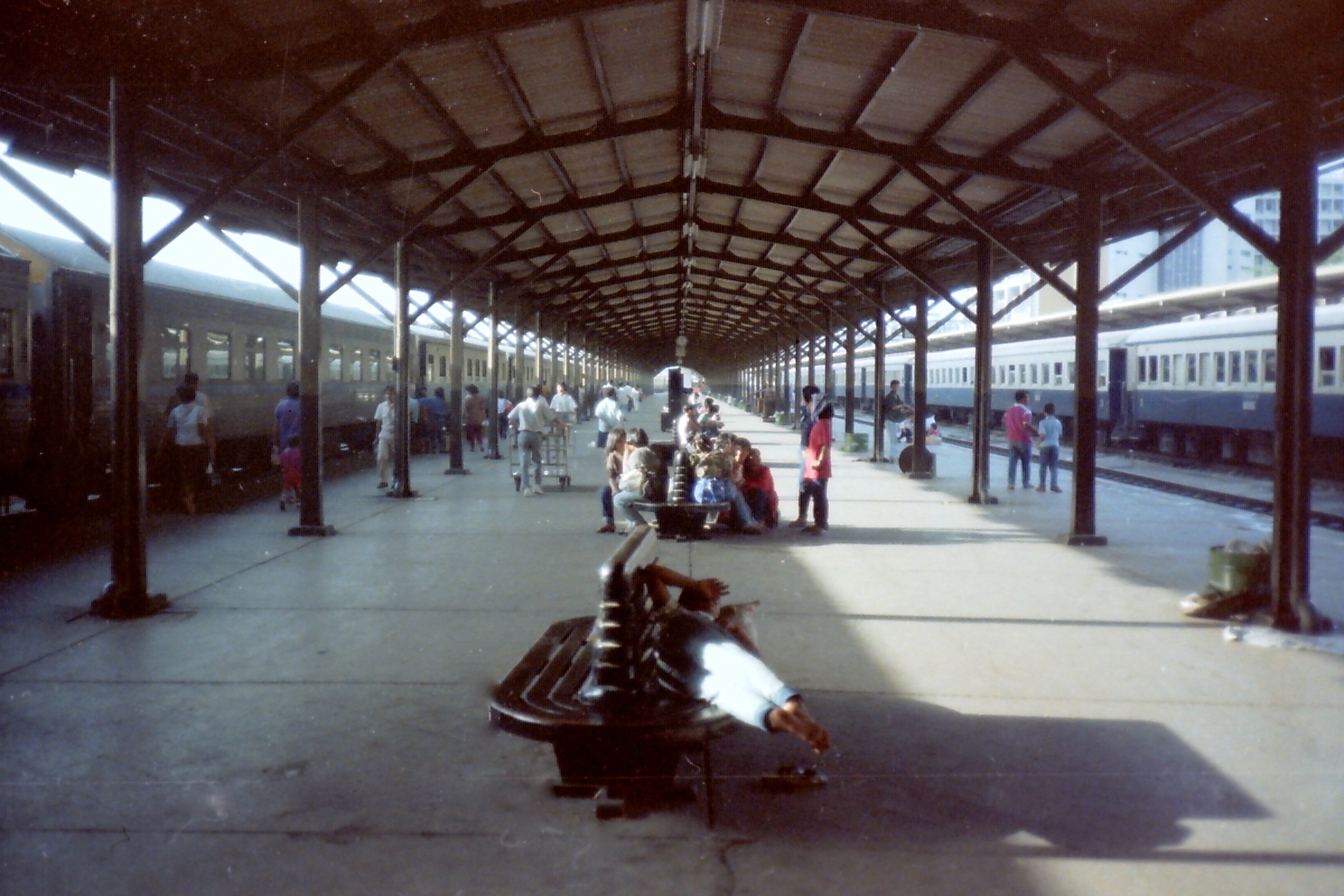
I booked a 2nd Class AC sleeper at Hualamphong Station and vacated the Malaysia Hotel.

I killed the six hours to the evening train at Kenny's Bar on Soi Duplei. Fon tried to convince me to blow off my departure. We had been friendly for several days. I promised to see her on my return to Bangkok.
"If I here. I here. Chok-dee.” We all needed good luck.

A Tuk-Tuk brought me to Bangkok's main station, Krung Thep Aphiwat. The train pulled out at dusk on time. 6:40 pm. and slowly snaked through the trackside ghettoes into the central plains. Sunset along with the black of night.

Dinner in the sleeping cars was strictly for farangs or foreigners. There was another option and I walked to the train’s rear car. A full Thai kitchen with tables and chairs. No farangs. I sat next to an open window. The wind warm.
I drank 80-proof Mekong Whiskey with off-duty cops in the dining car. They stripped off their shirts, Their skin glowed with sweat. Mine too. Buckets of ice chilled our drinks and the ice cubes slightly diluted the powerful liquor, but not enough, and I crashed in my A/C berth around midnight.

TThe next morning I woke with the dawn. Sleeping past that hour was discouraged by the staff. They kicked everyone out of the beds and gathered the sheets, blankets, and pillow cases. Breakfast was served by a surly porter. I headed for the dining car, where I poured the last of the Mekong into a cup of watery instant coffee. Kai Jiaoo or scambled eggs on rice was than the cold fried eggs with small hot dogs served in the sleeping cars..

The train pulled into the Chinag Mai station on time. 6:40. A tuk-tuk conveyed me over the Ping River to the Top North Guesthouse. On the narrow sois young children of all ages wore various school uniforms according to their grade. Sidewalk stalls fed the young and old in the Ancient City.
The Top North had been suggested by a police officer on the train. The hotel in the ancient city had a swimming pool. I spent most of midday wallowing in the shallow end. Once the sun dropped behind Doi Suthep, I wandered along narrow roads to ancient temples and beer bars near the old Silk Road city's brick fortifications and moat. Close by the East Gate, a farang bookshop rented dirt bikes.

125 cc MTXs and 250cc ATXs.
$10 OR $12 a day.
None of them were new. The studded tires in good shape.

The Aussie owner was yellowed by malaria. Tobie's wife glowered in the kitchen. She clearly didn't trust falangs or westerners.
"He's an American. Not an Israeli." Tobie wagged his nicotine-stained finger at his diminutive wife. A big Singha beer of a table. Not his first of the day.
"All farangs, all men, same. Kee," she said, wrapping herself in a wraith of wrath.

"Kee?" My Thai consisted basically of 'sawadee kap' and 'ek nung kyat beer' plus 'u-nai hong nam'. Hello and more beer were almost as important as 'where's the bathroom', since my stomach was having a hard time adjusting to Thai food.
"Kee means shit. The Thais are the French of the Orient. They think they are better than anyone else and in some ways they aren't wrong. This country had never conquered by the West." Tobie smiled at his wife, happy to be Free of the French, who were still despised in Laos, Cambodia, and Viet-Nam. Thais were happy to be Thais.

The Thais had supported the USA in Vietnam, but only had committed troops to Laos and survived the Communist avalanche to disprove the 'Domino Theory'. No battles had been fought in Lanna Thai for hundreds of years. I preferred mountain paths to battlefield and said to the Aussie, "I was thinking about taking a motorcycle trip."
"The North has great trails." He whipped out a map of the tribal hills skirting the Burma border. "None of the good ones are on a map."

"Mai Hong Son was one of the last market towns on the Silk Route." The broken nail on Jerry's index finger tapped a location to the west of Chiang Mai.
"You could fly there for $15. Driving on a dirt bike can take up to ten hours. It's hard riding and busts your ass. Every corner is a turn into the 15th century, especially in the dry season. The Thais are trying to pave it, but the steep hills devour the road like land sharks. This time of year the road has dust deep as your knees."
"Better than mud."

"Yes and no. What do you want rent?"
"I'll take the 250."
"Good choice."
I gave Tobie my passport as a guarantee and motored around town like Marlon Brando in THE WILD ONES. The bike's short pipes glowed red from the exhaust. The backfires spat out blue flames. I returned to the hotel and dropped into bed early. Ten hours on a bad road could easily become fifteen. Thailand was as famed for bad roads as was the North of Maine.

The next morning I ate a quick “jook’ or rice porridge. The barman at the Top North Guest House looked at the hazy sky and said, "Lon Mak."
And he was right about the heat.
It was already 91F and I drank a 'bon voyage' Singha. It was as cold as the air was hot.
After checking my bag with the hotel, I strapped a small daypack to the bike and set north from the old city. The Trans-Asia Highway was smooth as a baby's bottom.

50 Kilometers out of Chiang Mai was an elephant camp. Tourists rode the massive khangs through the forests. I snapped a few photos and kept on going. It was a long way to Mae Hang Son.
Heavy construction trucks labored up the two-laner. The road washing paved for the future. I weaved through the swatches of plowed road in 2nd gear and climbed into the mountains scarred by the slash-and-burn agriculture of the Hill Tribes. The centuries disappeared with every mile. I made good time to the Mai Hong Song turn-off. The centuries disappeared with every mile.
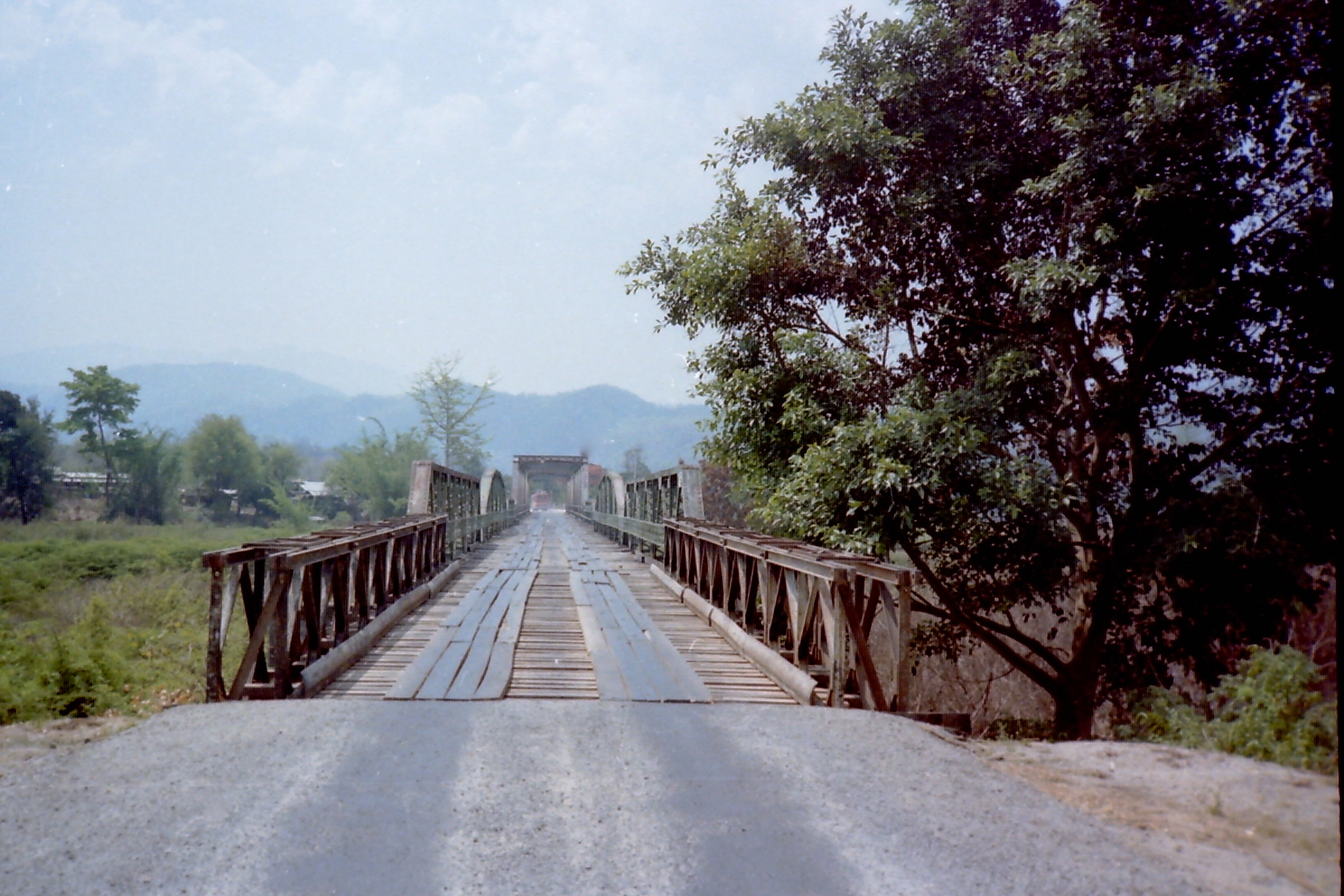
I made good time to the Mai Hong Song turn-off.
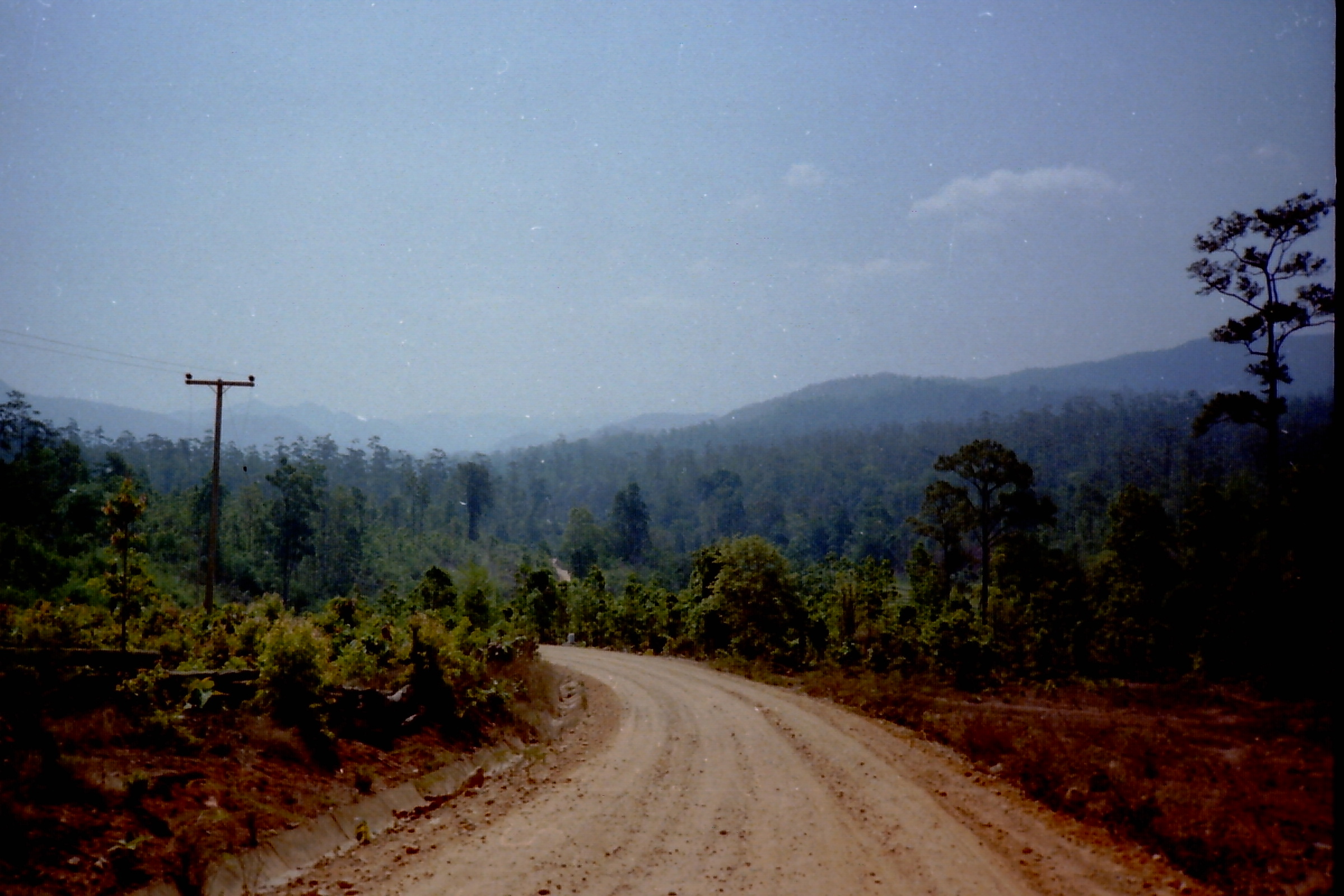
Outside of Pai the ankle-deep dust replaced the pavement. I wrapped a scarf over my mouth and nose. Sunglasses partially protected my eyes, but within a mile, powdery dirt coated my denims and dust caked my teeth and nostrils.

Opium trucks rolled past police barriers without inspection and I promised myself a taste in Mae Hong Song. Chasing the dragon or smoking opium would go good with a cold Singha.

As the sun rose in the hazy sky, the air grew too hot to breathe . The sun was strong enough to make me think that someone was ironing my skin. I drained my water bottle and looked up the word for water in a Thai dictionary. It was ‘nam'. Bottle was 'kuat' and I repeated both and sped by dry rice paddies, hoping to reach a village soon.
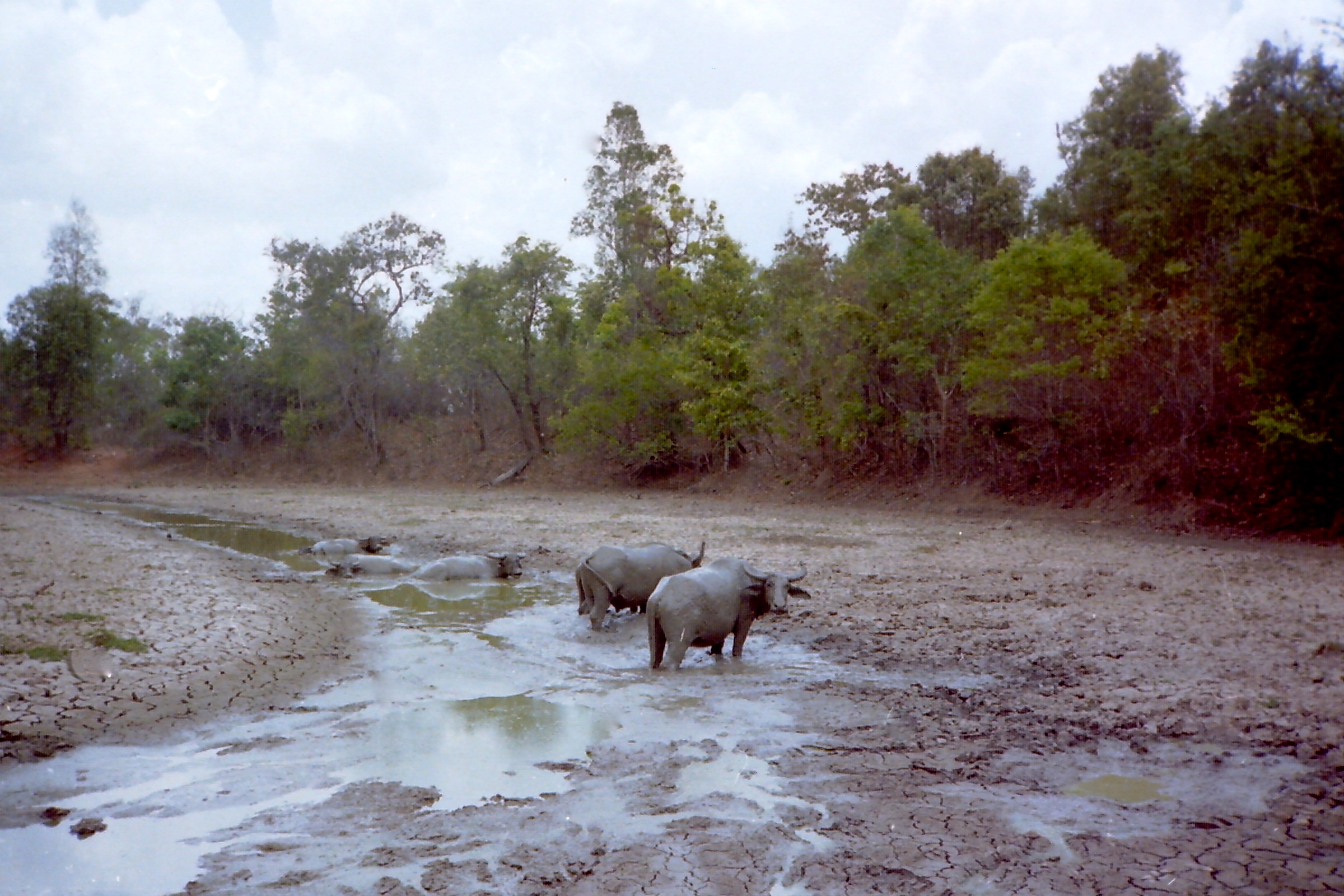
Water buffalo wallowed in troughs of mud.
Buffaloes were called 'kwaii' like the movie BRIDGE ON THE RIVER KWAII.

By noon I estimated the temperature in the high 90s.
There were no towns or villages. Only the road and dust. I twisted the accelerator to the max. The wind offered no relief.
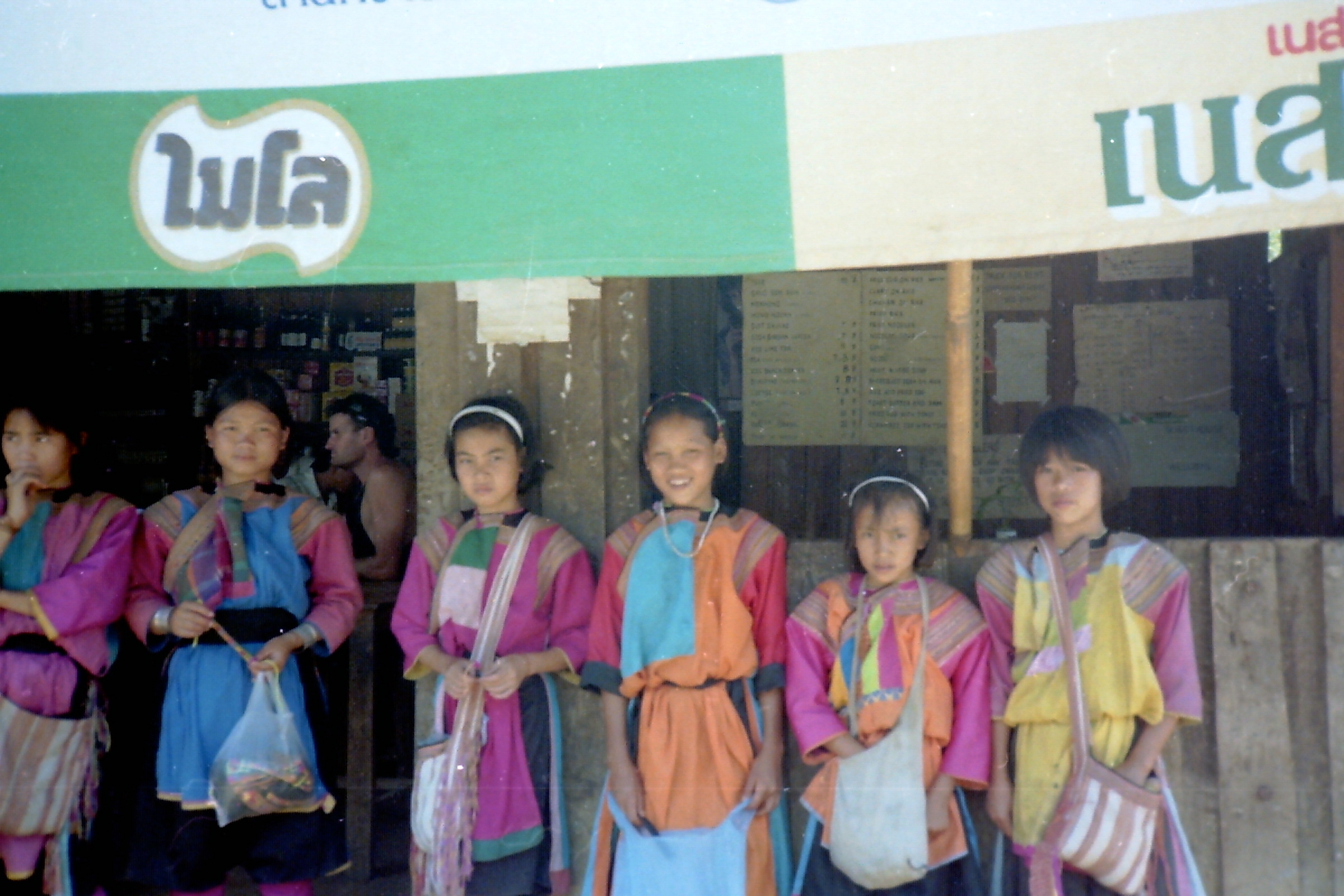
Fifty miles short of Mae Hong Son, I entered a Lisu village. The various tribes lived pre-industrial lives. The young tribal girls sold iced water. I bought three bottles and gave them all candy. They thanked me with a bowed 'wai'.

Two miles farther west I topped a pass. The hot season had scorched the trees brown. Parched leaves huddled at their trunks. Three buses were parked at the bottom of the valley. I slowed to a stop. Their passengers sheltered under withered trees’ miserly shade. The drivers gathered at the edge of a 10-meter bog. A trickling stream had transformed the red dirt into a thick muck. The Thais looked at me. I looked at them. We studied the seemingly impassable road.

One of the driver smoked a Krueng Tip cigarette.
He pointed to his knees to indicate the depth of the mud.
"Mai bpen rai," I said, which was all-purpose Thai phrase meaning 'no problem'.
I revved up the engine and the Thais shouted out, "Farang Bah."
I thought it was encouragement.

I maxxed out the 250cc engine. 6000 rpm.
A beautiful Lisu girl caught my eye.

I smiled at the twenty year-old and roared 200 meters back up the road for a good running start.
One of the drivers waved his hands to warn that crossing this mire was impossible.

He hadn't seen Evel Knievel leap over Caesar's fountains in Las Vegas and I u-turned the bike spraying a rat tail of damp earth. The Thai men on the roadside rose to their feet. The women stopped eating. The children ran closer to the soggy road. They knew that there was going to be a show. In their minds, all farangs were crazy. I goosed the accelerator and torgued out the bike at 7000 RPMs. I wasn't wearing a helmet.
My only protections were my courage and stupidity.
"Farang bah!" I shouted and raced toward the muck at full speed. The front wheel hydroplaned over the mud and then buried itself up to the fender, catapulting me into the air with outstretched arms like Superman. I was no George Reeves, the Original Man of Steel, and bellyflopped into the puddle.
I rose from the mud covered from head to foot like a troglodyte and the Thais laughed insanely, as the men hauled the stalled bike to the other side of the bog and I promised to buy them beer in Mai Hong Sing.
"Farang bah," shouted the driver.

I shook off the slop like a wet dog. The stranded Thai passengers laughed harder.
"Farang bah. Farang bah."
Later I learned that 'farang bah' meant 'crazy foreigner' and that I was. A farang bah, but I waved to the Lisu girl and she waved back. Seconds later I remounted the bike and punched my fist in the air before speeding away dripping clods of wet earth.
The sun baked the mud to every inch of my body. I loved riding in the mountains. I was free.
Mae Hong Song was a small town and I pulled into a restaurant across from a small temple and ordered beer. I drank several and each one tasted better than the previous one.

The bus rolled into town at sunset. The passengers sat down and joined me. They told the store owners the tale of my failed feat. I bought beers. Everyone laughed and the driver raised his bottle and said, "Chok dii."
Good luck.
"Chaii yo." I was happy not to have been hurt by my failed feat.
The Lisu girl sat at my table. She opened the paper bag and peeled off the insects’ antennae. “Khin.”
She stuck the body in her mouth. Legs and all. I obeyed and did the same. The grasshoppers were crunchy and tasted nutty. A great bar snack. I ordered ice for the beer. Cold Singha beer went well with fried grasshoppers and even better with mud.
The Thais retold my feat to each and every new Thai and let me give the punchline.
"Farang bah."
Each time it earned a big laugh, because even in a remote backwater like Mai Hong Song Thais were used to 'farang bah'.

Thanks for your support. In order to avoid ads, please donate to blogger.com.mangozeen through Venmo. Any amount will help us. I do have a large family. My Venmo account is @Peter.Smith.18
Plenty more to come___ Fotos by Peter Nolan Smith