Maine is the northern most state on the Eastern Seaboard. The distance from its southernmost border to the Potomac River is approximately 500 miles and in the winter of 1863 the 20th Maine Regiment crossed into Virginia to confront the Confederate forces at Fredericksburg. That summer they avenged the one-sided slaughter beneath St. Marye’s Height with the repelse of Pickett's desperate charge at Gettysburg.
“At that crisis, I ordered the bayonet. The word was enough.” The bare steel of Joshua Chamberlain’s troops repelled the threat to the Union left and the 20th Maine fought with distinction to war’s bitter end.
The mayhem of four bloody years ended at Appomattox and Colonel Chamberlain and the 20th Maine were present for the formal cessation of hostilities. As the rebel soldiers passed to surrender their arms and colors, Chamberlain ordered his troops to attention.
His memoir THE PASSING OF ARMIES captured the solemn dignity of their submission to a great force.
“Gordon, at the head of the marching column, outdoes us in courtesy. He was riding with downcast eyes and more than pensive look; but at this clatter of arms he raises his eyes and instantly catching the significance, wheels his horse with that superb grace of which he is master, drops the point of his sword to his stirrup, gives a command, at which the great Confederate ensign following him is dipped and his decimated brigades, as they reach our right, respond to the ‘carry.’ All the while on our part not a sound of trumpet or drum, not a cheer, nor a word nor motion of man, but awful stillness as if it were the passing of the dead.”
More vengeful Northerners had regarded his chivalry as treason, however to his fellow soldiers Chamberlain’s gesture had signaled the resumption of brotherhood and the State of Maine had commemorated the sacrifice of their native sons with bronze statues of facing south. The defeat of the Confederacy had liberated millions of slaves. Few ventured north of the Potomac and by the middle of the 20th Century the black communities of Bangor and Lewiston numbered about 6000 out of a population of one million souls living within the borders of the Pine State.
In 1954 Maine was the whitest state in the USA.
That spring my father was transferred by New England Telephone from Boston to Portland. My mother and he looked for a house close to the city and found a newly-built three-bedroom house on Falmouth Foresides. Eastern Heights lay across the harbor. The scent of the sea mixed with the fragrance of fresh bread from the Nissen Bakery on the Back Cove. Work at the phone company was a ten-minute drive down US1.
The neighborhood was filled with young couples like themselves. The hordes of children from the Baby Boom played on the lawns and my parents wanted this house on McKinley Road to be their home.
After the agent agreed to a closing price my mother asked, if there was a nearby Catholic church.
She was Irish-Catholic out of Jamaica Plains. Her family were city people.
“Are you Catholic?” The real estate agent made a face. Maine was predominantly Protestant.
“Yes.” Our last name was Yankee, but my father had converted to marry my first-generation Irish mother. He loved her that much. “You have a problem with that?”
“I guess it’s okay. We have Jews living on the next street.” The man shrugged with indifference. He lived on Bailey’s Island in a house over two hundred years old.
Catholics and Jews belonged in this neighborhood and not his.
“Thanks for telling us.” My father was a Maine native and his family had arrived in the New World on the Mayflower.
“What about the house?”
“We’ll let you know.”
His comments had kiboshed the deal and my father sought out a real estate agency with a French-Canadian name. Canucks were Maine’s real minority. The woman selling the house was Mrs. Benoit. The petite brunette lived in the neighborhood and knew the seller. Hearing about the other agent’s comments, she loped a thousand dollar off the price.
“I’ll see you in church.”
We moved into the house and our family paid little attention to our minority status. My older brother, younger sister, and I were blonde-haired and blue-eyed. My mother’s Hibernian beauty and her soaring alto were welcome additions to cocktail parties in the coastal suburb north of Portland. They became best friends with the Noyes and the years passed into the late 50s.
Mrs. Noyes’ oldest son was my age. Chaney was my best friend. We attended a one-room schoolhouse off US 1. Mornings began with the Pledge of Allegiance and a prayer. We were loyal American and the stigma of Catholicism was never mentioned in school, however my mother never failed to express her loyalty to her Irish blood with green milk on St. Patrick’s Day and the IRA call to arms, “Up the rebels.”
Our world was our neighborhood, the school, and church until my father brought home a Zenith black/white TV. My older brother and I were soon obsessed with the Red Sox, HOWDY DOODY, BOZO THE CLOWN, THE YOUNG RASCALS, and THE THREE STOOGES.
“Moe, Larry, cheese.” Curly’s cry for the calming cure of cheese was the height of humor for boys under the age of six.
“Idiots.” My father hated my comic idols and threatened to throw out the boob tube, however my mother had reserved Sunday evening as family night and my father drove into Portland to buy two pizzas, which we ate in the living room watching LASSIE to THE ED SULLIVAN SHOW on CBS.
At Eight o’Clock my father ordered my older brother, younger sister, and me to bed.
One November night my mother let me stay up a little longer to see her favorite program.
“He should be in bed.” My father scrunched his mouth in frustration. His one-on-one time with my mother was governed by our sleeping.
“He wants to be with me.” My childhood was slipping from my bones.
“You’ll spoil him.”
“He’ll turn out just like you, won’t you?” Her hand brushed my crew cut. Our town was plagued by lice. My father owned electric clippers and shorn our skulls to the bones twice a month.
“Yes, m’am.” I hugged her with all my might.
She smelled of fresh bread. The whole house smelled the same. The wind was from the south and Nissan Bakery was working a night shift.
“Be quiet and don’t ask any questions. Your father likes this show.”
Throughout the opening segment of THE JACK BENNY SHOW my parents laughed at Jack Benny’s stinginess and the man who said, “Yeeee-essss?”. I didn’t laugh with them, but came to life when a dark-skinned man appeared on the TV.
“A chocolate man.”
Jack Benny’s servant was darker than a Hershey Bar. His face was round and his hair was slick as a grease stain at the garage on Route 1.
“He’s not a chocolate man.” My father’s voice spiked with exasperation. He wanted to watch his program without my interruption. “He’s Rochester.”
“Rochester?” My teacher had taught the classroom a song about his kind. “You mean like Little Black Sambo?”
“No, he’s called a negro or colored.” My mother informed me.
"His people came from Africa as slaves. A war was fought to free them.”
“Like Moses freed the Israelites?” I attended Sunday school after Mass. Our teacher had read us Exodus this morning.
“Yes, only he negroes' Moses was Abraham Lincoln. His face is on the penny.”
“Why’s he speaking different from us?”
A commercial came on the TV and my mother stood up to clear off the plates.
“They have their own way of speaking,” she said on her way into the kitchen.
“You mean like Chaney’s grandmother?” Shane’s white-haired grandmother spoke German. She had been born in Europe.
“No, they speak another version of English. You know Amos and Andy?” My father believed in telling us the truth as he saw it.
“Yes.” I had heard them on the radio.
“Those are Negroes too.” He explained and added that their roles were stereotypes.
“If blacks are on TV, why don’t they live with us?”
“Negroes live in their own communities. It’s better that way. Everyone staying with their own kind.” My mother re-entered the living room. She was from Jamaica Plain in Boston. Her neighborhood was Irish. She had met my father in the elevator of the 51 Oliver Street Telephone Building.
“You’re Irish and Dad’s English. Shouldn’t you have stayed with your own kind?”
“That’s different.”
“How?” I had no idea about kinds.
“Just is?” My mother’s patience was wearing thin. She wanted peace and quiet and most of all golden silence during these Sunday TV sessions and what my mother wanted she got from both my father and us.
I ceased to call Rochester a ‘Chocolate Man’, but at Underwood Primary School our classmates explored the borders of kind. Steve Gordon was a Yid. Shane Benoit was called a ‘Canuck’. My brother and I were Micks. There were no Negroes.
When Chaney joked in class about “Micks’, our teacher, Miss Stange, lectured the K-2 students on race.
“I don’t want to hear that word again or any of the other words,” warned the stout teacher. "And if you do, I'll tell your parents."
“But they’re the ones saying these words,” Chaney said and Miss Stange ordered him into the corner.
“It’s true. Our fathers call German, Italians, and Japanese ‘Krauts’ ‘Wops’, and ‘Japs’.”
I joined Chaney in the corner, but what I had said was true.
Different kinds were called different names.
During our Davy Crockett phase we killed thousands of ‘Spics’ surrounding the Alamo.
Negroes were spared our bullets, because we knew none and Boston Celtics’ Bill Russell was a Negro. His stop of a Syracuse National player’s shot at the end of overtime had stolen the voice of Johnny Most, the Celtics radio announcer.
Steven Gordon had been to Boston Garden and informed us that the Celtics’ Jones boys were not brothers. They weren’t black either.
“More brown like different shades of chocolate. And they don’t like being called ‘negro’ or ‘colored’. They want to called ‘black’.” Steven went on to say that he didn’t want to hear the words ‘kike’ or ‘yid’.
Steven was bigger than the rest of us and his father let us watch Red Sox baseball games on their color TV. The entire team was white. Only three teams in the American League had black players; Carlos Paula of the Washington Senators, Ozzie Virgil of the Detroit Tigers, and Elston Howard of the Damned Yankees.
That summer the Red Sox finished 3rd in the league. Steven Gordon’s father said that they needed a black player like Satchel Paige.
“Who was Satchel Paige?” I asked in total ignorance.
“Only the best pitcher of all time. He couldn’t play in the big leagues, because of the color clause. No blacks. No way.” Steven’s father was a tall man with a big nose. He liked to fish on the dock at the end of the street. He gave his catch to the poorer families in the town.
“He played for the St. Louis Browns in 1948. Subbed for Bob Lemon. He took it soft on the first two batters, but struck out Whitey Platt so bad that he lost touch the grip of his bat and it ended up down near 3rd base,” Mr. Gordon recounted the at-bat, as if he had been there that day. “He would have been rookie of the year, except he was 42. Best pitcher ever was.”
Chaney, my older brother, and I accepted his judgment.
Mr. Gordon knew his baseball.
After that every time my family went into Portland for dinner, I searched the streets for a black face. There were none downtown or on the docks. My Aunt Sally said that Westbrook had a black postman and supposedly migrant workers from Jamaica picked apples in the orchard farms.
No one else had seen one either, so I served as a substitute for our neighborhood, because my summer tan was darker than that of my brothers and sisters.
My mother called me ‘Black Irish’ and explained, “After the failure of the Spanish Armada the galleons sailed along the coast of Western Ireland. Many of the ship were wrecked on the rocks. Some of the survivors were Moors from Africa. Maybe a little of their tar got in your blood.”
Labor Day Weekend families deserted the Foresides. Chaney went to Sebago Lake. Danny Benoit’s family drove north to visit his grandmother in Quebec. My grandmother had a cabin on Watchic Pond. Steven Gordon spent the long weekend in Boston and upon his return, he said, “There are hundreds of blacks moving into Roxbury.”
He made it sound like an invasion.
“Why?” I thought blacks stayed far from the North, because the climate was too cold.
“Because the KKK down south are hanging them from the trees. Lynchings. Murder. Burning houses.”
“Why?”
“Because they don’t know their place,” Steven said with sadness. “The Nazis treated the Jews the same”
“My grandmother had to leave Prague, because she was a commie.” Chaney’s grandmother was a sweet old woman. Her apple pie was spiced with cinnamon. It was good enough to be a sin.
“A commie?” Nothing was worse than being a commie in the 50s.
“Not really, but her name was on a list.”
She had told us many times about escaping the Nazis by riding on top of a train. Chaney’s mother had been 10. My grandmother left Ireland at age 14. Nana told a story about an uncle shot by the Black and Tans. My mother had few good words for the British.
That fall I watched THE JACK BENNY SHOW with a hidden agenda. Jack Benny’s character treated his valet more as a friend than a worker and with good reason. Rochester was smarter than the rest of the cast. My older brother and I laughed at his jokes. They were actually funny.
A few days short of the Columbus Day holiday my father, mother, and my younger sisters and brother traveled south to Boston. My older brother and I had school. My grandmother took care of us throughout the week. On Friday Edith packed a bag and drove us to Union Station below Western Promenade. She parked her new VW Beetle and we walked inside the granite building to buy tickets.
Only two.
“I’m not going with you, but don’t worry the porters will take care of you.”
“Porters?” Surprises were reserved for cheeseburgers at Simpson’s In The Woods or a trip to Old Orchard Beach. I had never been with a stranger.
“Don’t worry, they knew your grandfather. He treated them like people.”
My grandfather had been a general practitioner in Westbrook. He had been dead since 1952, but people still came to the office door for help. They said that he had been a good man.
"You're not coming?" I thought it was a joke.
"You'll be fine." Edith sat us on a passenger car. There were three other travelers. They looked foreign, maybe Canadian.
Our tickets were stuck on the seat. Paper name tags
pinned to our jackets. Our grandmother handed us two Italian sandwiches without onions and peppers with two bottles of Orange Crush plus $5.
“Your mother will be waiting at the other end. North Station. Think of this as your first adventure. You know your great-grand-aunt Bert sailed around the world when she was only 8.”
I wouldn’t be eight for another two years. Our days so far had been strictly supervised by parents, teachers, family, and babysitters.
This couldn’t be right. Someone had persuaded our grandmother to sell us into slavery. This awful person must have paid here $1000. That was the price for a new Volkswagen.
Edith waved from the covered platform. The train pulled out of the station. My older brother clutched my hand as tightly as he had seized my body after our father threw us into the lake last summer.
His father had taught him the same ‘sink or swim’ technique off the same dock.
My brother had climbed on my back. My head had sunk underwater. I had fought to get him off me. My father had rescued us by standing us up.
The water was only chest-deep.
My grandmother, Uncle Russ, Aunt Sally, and my sisters and brother laughed at our discovery.
My mother didn’t think it was so funny.
“Six inches is enough to drown in.” Mothers liked their children safe.
I didn't feel safe. The train was picking up speed. Jumping off was not an option.
"Tickets, please."
I turned around to see a giant black man in a uniform approaching our seats. His skin was the color of burnt coal. I tapped my brother on the leg.
“A chocolate man,” I whispered in the voice taught by older boys in our grammar school.
“Ain’t no chocolate this dark.” His voice rumbled like the words were forged from thunder in his large belly. “I think of myself as the color of black coffee. No milk. No cream. But plenty of sugar. Black as Africa. You ever seen a black man before?”
“No, sir,” my brother and I replied with a machine gun stutter.
“Then the times there are truly a-changin’. White boys callin’ a colored man ‘sir’.” He pocketed our tickets and leaned over to check out the name tags. His over-sized body smelled different from my father.
“We’re not supposed to call black men ‘colored’.” My answer straightened up the porter.
“And who told you that?” The hands resting on his hips were the size of my head.
“Me and my friends decided that. We don’t like what the KKK is doing,” My older brother usually spoke with better grammar.
“Is that so?” His yellow-rimmed eyes were taking no prisoner.
“Yes, sir.” My hands trembled so fast that my soda was fizzling.
The conductor snatched the bottle from my hand and wiped the foam with a snow-white napkin.
“Sorry to scare you like that. You the grandsons of Doctor Smith. He was good to my people. I’ll be as good to you. My name is Leroy Brown. But you call me Leroy.”
His smile lit my heart afire like a nuclear bomb in the Nevada desert melting our frozen fear.
“Good to meet you, Leroy.” I offered my hand. His swallowed mine.
In our family children were to be seen a little and heard even less, but I asked without any hesitation, “Do you know Bill Russell?”
“Do I know Bill Russell?” His laugh shivered the windows. “This train’s final destination is North Station. Above the station is the Boston Garden.”
“The home of the Boston Celtics.” My older brother had found his nerve too.
“The 1958 Champions and next year too.”
“The Jones Boys.”
“KC and Sam.”
“You know your basketball. I see Bill Russell from time to time. He’s a warrior on the hardwoods and I’ll tell you why after this stop.” The train pulled into Old Orchard Beach.
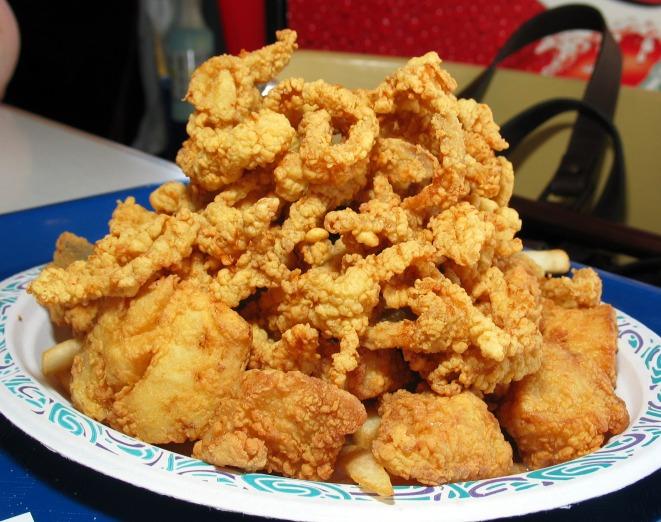
Gordon’s Fried Clams was down the street. The amusement park was opening for the short summer season. I loved the fun house called NOAH'S ARK. My brother and I stuck straws in our sodas and unfolded the Italians on our laps. Leroy joined us half way through the sandwiches.
“I like them too. Good eating. Cheap too. Now where were we?” We lived the 1957 Championship season game by game through Saco, Wells, Dover, Exeter, Haverhill, and Woburn. He added an aside that Woburn was the birthplace of the fried clams.
“A trainman fried them up in batter. Woodman’s in Essex claims the honor, but we railmen know the truth. Your other grandfather was one of us. Trolley man out of Forest Hills. Anyway Game 7 had a few seconds left in regulation. Inbounds pass to Coleman. Russell is on the baseline, but blocks the shot. Overtime with only seven Hawks left on the bench. Game 127-125. Bob Petit’s shot rolls around the rim and out. Celtics win their first championship.”
The men listening to Leroy’s recounting of that game burst into applause. The Red Sox hadn’t played in the World Series since 1918 and the Bruins were exiled to the lower ranks of the NHL. One black man had brought Boston the Big Win.
Bill Russell.
The train crossed a river.
“Only a few more minutes to North Station. Been good ridin’ with you boys. Your grandfather was a good man and they ain’t easy to find. You have any idea how your kind treat us?”
“No.” I wasn’t sure what my kind was.
“
"You can keep a secret?” His voice rustled from his throat with a hush of dried leaves.
“Yes.” It was another year until my First Confession.
“Your kind treats my kind like we aren’t as good as them and I have to pretend that is the truth or else.”
His eyes seared fear into ours. Steven Gordon had spoken about the whips and chains. I shuddered with the horror that Leroy and his kind had been treated worse than bad by my kind and the laughter on THE JACK BENNY show was proof that my kind thought that Rochester was funny for another reason other than being funny.
I didn’t know what to say.
“Don’t say sorry. You ain’t don’t nothing wrong yet, have you?” He had been hurt in his life by the names white people called his kind and they had suffered pain worse than sticks and stones.
We shook our heads.
“Your grandfathers and grandmothers aren’t like the rest of you white people. They were good people.” Leroy stood up with a grin and this smile said a better time was coming. No one could say when.
The train pulled into the North Station. The passengers gathered their possessions from the overhead racks. Leroy escorted us off the train. My mother and father waited
on the platform with my Irish grandmother. Nana gave Leroy a tip of $5.
“Thank you, m’am.” Leroy tugged on the visor of his cap with a wink of the eye. His secret was safe with us.
“You boys have a good time in Boston.”
“Yes, sir.”
“The name’s Leroy. It means the King in French.”
Leroy walked down the platform into a crowd of white people.
My Nana hugged me, as if I had crossed the Atlantic.
I looked for another black face. There were none.
My mother kissed me on the cheek. My father pointed above us.
“
That’s where the Celtics and Bruins play.”
“Boston Garden.” I looked for Bill Russell, as we walked to the trolley station.
His number was 6.
He was not a chocolate man.
Leroy wasn't either.
No one was.
Not even a young Black Irish boy from Maine and I was glad of that, because I liked my chocolate to be chocolate.